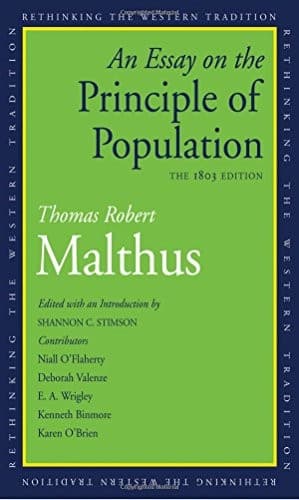
An Essay on the Principle of PopulationMalthus, T. R. (Thomas Robert)
Philosophy
An Essay on the Principle of Population
Malthus, T. R. (Thomas Robert)
Population
I entirely acquit Mr Pitt of any sinister intention in that clause of
his Poor Bill which allows a shilling a week to every labourer for each
child he has above three. I confess, that before the bill was brought
into Parliament, and for some time after, I thought that such a
regulation would be highly beneficial, but further reflection on the
subject has convinced me that if its object be to better the condition
of the poor, it is calculated to defeat the very purpose which it has
in view. It has no tendency that I can discover to increase the produce
of the country, and if it tend to increase the population, without
increasing the produce, the necessary and inevitable consequence
appears to be that the same produce must be divided among a greater
number, and consequently that a day's labour will purchase a smaller
quantity of provisions, and the poor therefore in general must be more
distressed.
I have mentioned some cases where population may permanently increase
without a proportional increase in the means of subsistence. But it is
evident that the variation in different states, between the food and
the numbers supported by it, is restricted to a limit beyond which it
cannot pass. In every country, the population of which is not
absolutely decreasing, the food must be necessarily sufficient to
support, and to continue, the race of labourers.
Other circumstances being the same, it may be affirmed that countries
are populous according to the quantity of human food which they
produce, and happy according to the liberality with which that food is
divided, or the quantity which a day's labour will purchase. Corn
countries are more populous than pasture countries, and rice countries
more populous than corn countries. The lands in England are not suited
to rice, but they would all bear potatoes; and Dr Adam Smith observes
that if potatoes were to become the favourite vegetable food of the
common people, and if the same quantity of land was employed in their
culture as is now employed in the culture of corn, the country would be
able to support a much greater population, and would consequently in a
very short time have it.
Public-domain text, read in full here on John Shaqi.
Reviews
Reviews
No reviews yet
Be the first to share your thoughts on this work.
Join the Discussion
Join the discussion
Sign in to leave a comment or review.
Sign InorCreate an account