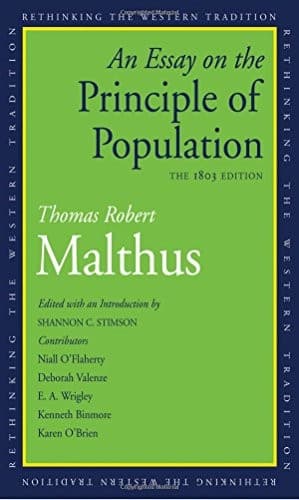
An Essay on the Principle of Population — John Shaqi
An Essay on the Principle of PopulationMalthus, T. R. (Thomas Robert)
Philosophy
An Essay on the Principle of Population
Malthus, T. R. (Thomas Robert)
Population
The happiness of a country does not depend, absolutely, upon its
poverty or its riches, upon its youth or its age, upon its being thinly
or fully inhabited, but upon the rapidity with which it is increasing,
upon the degree in which the yearly increase of food approaches to the
yearly increase of an unrestricted population. This approximation is
always the nearest in new colonies, where the knowledge and industry of
an old state operate on the fertile unappropriated land of a new one.
In other cases, the youth or the age of a state is not in this respect
of very great importance. It is probable that the food of Great Britain
is divided in as great plenty to the inhabitants, at the present
period, as it was two thousand, three thousand, or four thousand years
ago. And there is reason to believe that the poor and thinly inhabited
tracts of the Scotch Highlands are as much distressed by an overcharged
population as the rich and populous province of Flanders.
Were a country never to be overrun by a people more advanced in arts,
but left to its own natural progress in civilization; from the time
that its produce might be considered as an unit, to the time that it
might be considered as a million, during the lapse of many hundred
years, there would not be a single period when the mass of the people
could be said to be free from distress, either directly or indirectly,
for want of food. In every state in Europe, since we have first had
accounts of it, millions and millions of human existences have been
repressed from this simple cause; though perhaps in some of these
states an absolute famine has never been known.
Famine seems to be the last, the most dreadful resource of nature. The
power of population is so superior to the power in the earth to produce
subsistence for man, that premature death must in some shape or other
visit the human race. The vices of mankind are active and able
ministers of depopulation. They are the precursors in the great army of
destruction; and often finish the dreadful work themselves. But should
they fail in this war of extermination, sickly seasons, epidemics,
pestilence, and plague, advance in terrific array, and sweep off their
thousands and ten thousands. Should success be still incomplete,
gigantic inevitable famine stalks in the rear, and with one mighty blow
levels the population with the food of the world.
Must it not then be acknowledged by an attentive examiner of the
histories of mankind, that in every age and in every state in which man
has existed, or does now exist.
That the increase of population is necessarily limited by the means of
subsistence.
That population does invariably increase when the means of subsistence
increase. And that the superior power of population it repressed, and
the actual population kept equal to the means of subsistence, by misery
and vice?
CHAPTER 8
Public-domain text, read in full here on John Shaqi.
Reviews
Reviews
No reviews yet
Be the first to share your thoughts on this work.
Join the Discussion
Join the discussion
Sign in to leave a comment or review.
Sign InorCreate an account