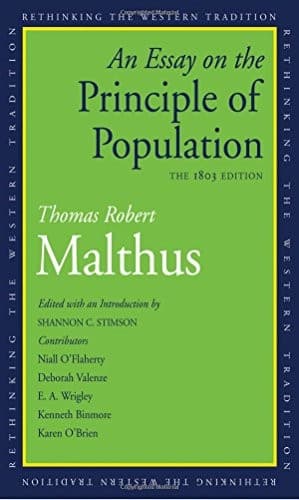
An Essay on the Principle of PopulationMalthus, T. R. (Thomas Robert)
Philosophy
An Essay on the Principle of Population
Malthus, T. R. (Thomas Robert)
Population
This posthumous publication is only a sketch of a much larger work,
which he proposed should be executed. It necessarily, therefore, wants
that detail and application which can alone prove the truth of any
theory. A few observations will be sufficient to shew how completely
the theory is contradicted when it is applied to the real, and not to
an imaginary, state of things.
In the last division of the work, which treats of the future progress
of man towards perfection, he says, that comparing, in the different
civilized nations of Europe, the actual population with the extent of
territory, and observing their cultivation, their industry, their
divisions of labour, and their means of subsistence, we shall see that
it would be impossible to preserve the same means of subsistence, and,
consequently, the same population, without a number of individuals who
have no other means of supplying their wants than their industry.
Having allowed the necessity of such a class of men, and adverting
afterwards to the precarious revenue of those families that would
depend so entirely on the life and health of their chief, he says, very
justly: 'There exists then, a necessary cause of inequality, of
dependence, and even of misery, which menaces, without ceasing, the
most numerous and active class of our societies.' (To save time and
long quotations, I shall here give the substance of some of Mr
Condorcet's sentiments, and hope I shall not misrepresent them. But I
refer the reader to the work itself, which will amuse, if it does not
convince him.) The difficulty is just and well stated, and I am afraid
that the mode by which he proposes it should be removed will be found
inefficacious. By the application of calculations to the probabilities
of life and the interest of money, he proposes that a fund should be
established which should assure to the old an assistance, produced, in
part, by their own former savings, and, in part, by the savings of
individuals who in making the same sacrifice die before they reap the
benefit of it. The same, or a similar fund, should give assistance to
women and children who lose their husbands, or fathers, and afford a
capital to those who were of an age to found a new family, sufficient
for the proper development of their industry. These establishments, he
observes, might be made in the name and under the protection of the
society. Going still further, he says that, by the just application of
calculations, means might be found of more completely preserving a
state of equality, by preventing credit from being the exclusive
privilege of great fortunes, and yet giving it a basis equally solid,
and by rendering the progress of industry, and the activity of
commerce, less dependent on great capitalists.
Public-domain text, read in full here on John Shaqi.
Reviews
Reviews
No reviews yet
Be the first to share your thoughts on this work.
Join the Discussion
Join the discussion
Sign in to leave a comment or review.
Sign InorCreate an account