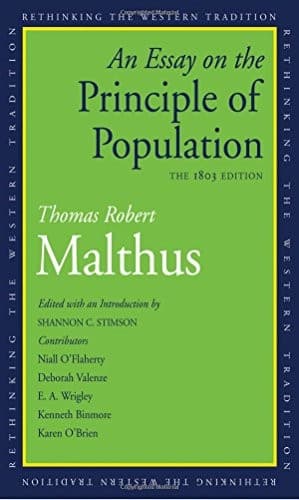
An Essay on the Principle of PopulationMalthus, T. R. (Thomas Robert)
Philosophy
An Essay on the Principle of Population
Malthus, T. R. (Thomas Robert)
Population
Mr Wallace--Error of supposing that the difficulty arising from
population is at a great distance--Mr Condorcet's sketch of the
progress of the human mind--Period when the oscillation, mentioned by
Mr Condorcet, ought to be applied to the human race.
To a person who draws the preceding obvious inferences, from a view of
the past and present state of mankind, it cannot but be a matter of
astonishment that all the writers on the perfectibility of man and of
society who have noticed the argument of an overcharged population,
treat it always very slightly and invariably represent the difficulties
arising from it as at a great and almost immeasurable distance. Even Mr
Wallace, who thought the argument itself of so much weight as to
destroy his whole system of equality, did not seem to be aware that any
difficulty would occur from this cause till the whole earth had been
cultivated like a garden and was incapable of any further increase of
produce. Were this really the case, and were a beautiful system of
equality in other respects practicable, I cannot think that our ardour
in the pursuit of such a scheme ought to be damped by the contemplation
of so remote a difficulty. An event at such a distance might fairly be
left to providence, but the truth is that if the view of the argument
given in this Essay be just the difficulty, so far from being remote,
would be imminent and immediate. At every period during the progress of
cultivation, from the present moment to the time when the whole earth
was become like a garden, the distress for want of food would be
constantly pressing on all mankind, if they were equal. Though the
produce of the earth might be increasing every year, population would
be increasing much faster, and the redundancy must necessarily be
repressed by the periodical or constant action of misery or vice.
Mr Condorcet's Esquisse d'un Tableau Historique des Progres de l'Esprit
Humain, was written, it is said, under the pressure of that cruel
proscription which terminated in his death. If he had no hopes of its
being seen during his life and of its interesting France in his favour,
it is a singular instance of the attachment of a man to principles,
which every day's experience was so fatally for himself contradicting.
To see the human mind in one of the most enlightened nations of the
world, and after a lapse of some thousand years, debased by such a
fermentation of disgusting passions, of fear, cruelty, malice, revenge,
ambition, madness, and folly as would have disgraced the most savage
nation in the most barbarous age must have been such a tremendous shock
to his ideas of the necessary and inevitable progress of the human mind
that nothing but the firmest conviction of the truth of his principles,
in spite of all appearances, could have withstood.
Public-domain text, read in full here on John Shaqi.
Reviews
Reviews
No reviews yet
Be the first to share your thoughts on this work.
Join the Discussion
Join the discussion
Sign in to leave a comment or review.
Sign InorCreate an account