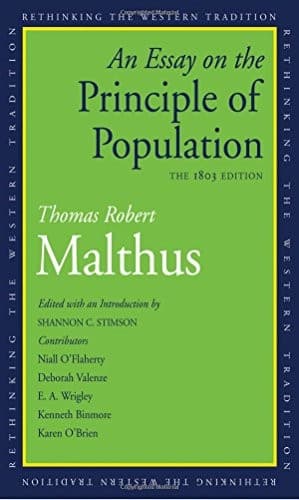
An Essay on the Principle of Population — John Shaqi
An Essay on the Principle of PopulationMalthus, T. R. (Thomas Robert)
Philosophy
An Essay on the Principle of Population
Malthus, T. R. (Thomas Robert)
Population
In entering upon the argument I must premise that I put out of the
question, at present, all mere conjectures, that is, all suppositions,
the probable realization of which cannot be inferred upon any just
philosophical grounds. A writer may tell me that he thinks man will
ultimately become an ostrich. I cannot properly contradict him. But
before he can expect to bring any reasonable person over to his
opinion, he ought to shew that the necks of mankind have been gradually
elongating, that the lips have grown harder and more prominent, that
the legs and feet are daily altering their shape, and that the hair is
beginning to change into stubs of feathers. And till the probability of
so wonderful a conversion can be shewn, it is surely lost time and lost
eloquence to expatiate on the happiness of man in such a state; to
describe his powers, both of running and flying, to paint him in a
condition where all narrow luxuries would be contemned, where he would
be employed only in collecting the necessaries of life, and where,
consequently, each man's share of labour would be light, and his
portion of leisure ample.
I think I may fairly make two postulata.
First, That food is necessary to the existence of man.
Secondly, That the passion between the sexes is necessary and will
remain nearly in its present state.
These two laws, ever since we have had any knowledge of mankind, appear
to have been fixed laws of our nature, and, as we have not hitherto
seen any alteration in them, we have no right to conclude that they
will ever cease to be what they now are, without an immediate act of
power in that Being who first arranged the system of the universe, and
for the advantage of his creatures, still executes, according to fixed
laws, all its various operations.
I do not know that any writer has supposed that on this earth man will
ultimately be able to live without food. But Mr Godwin has conjectured
that the passion between the sexes may in time be extinguished. As,
however, he calls this part of his work a deviation into the land of
conjecture, I will not dwell longer upon it at present than to say that
the best arguments for the perfectibility of man are drawn from a
contemplation of the great progress that he has already made from the
savage state and the difficulty of saying where he is to stop. But
towards the extinction of the passion between the sexes, no progress
whatever has hitherto been made. It appears to exist in as much force
at present as it did two thousand or four thousand years ago. There are
individual exceptions now as there always have been. But, as these
exceptions do not appear to increase in number, it would surely be a
very unphilosophical mode of arguing to infer, merely from the
existence of an exception, that the exception would, in time, become
the rule, and the rule the exception.
Public-domain text, read in full here on John Shaqi.
Reviews
Reviews
No reviews yet
Be the first to share your thoughts on this work.
Join the Discussion
Join the discussion
Sign in to leave a comment or review.
Sign InorCreate an account