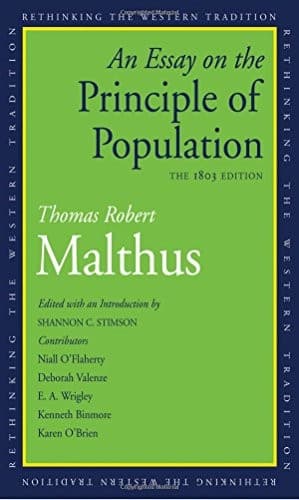
An Essay on the Principle of PopulationMalthus, T. R. (Thomas Robert)
Philosophy
An Essay on the Principle of Population
Malthus, T. R. (Thomas Robert)
Population
I have read some of the speculations on the perfectibility of man and
of society with great pleasure. I have been warmed and delighted with
the enchanting picture which they hold forth. I ardently wish for such
happy improvements. But I see great, and, to my understanding,
unconquerable difficulties in the way to them. These difficulties it is
my present purpose to state, declaring, at the same time, that so far
from exulting in them, as a cause of triumph over the friends of
innovation, nothing would give me greater pleasure than to see them
completely removed.
The most important argument that I shall adduce is certainly not new.
The principles on which it depends have been explained in part by Hume,
and more at large by Dr Adam Smith. It has been advanced and applied to
the present subject, though not with its proper weight, or in the most
forcible point of view, by Mr Wallace, and it may probably have been
stated by many writers that I have never met with. I should certainly
therefore not think of advancing it again, though I mean to place it in
a point of view in some degree different from any that I have hitherto
seen, if it had ever been fairly and satisfactorily answered.
The cause of this neglect on the part of the advocates for the
perfectibility of mankind is not easily accounted for. I cannot doubt
the talents of such men as Godwin and Condorcet. I am unwilling to
doubt their candour. To my understanding, and probably to that of most
others, the difficulty appears insurmountable. Yet these men of
acknowledged ability and penetration scarcely deign to notice it, and
hold on their course in such speculations with unabated ardour and
undiminished confidence. I have certainly no right to say that they
purposely shut their eyes to such arguments. I ought rather to doubt
the validity of them, when neglected by such men, however forcibly
their truth may strike my own mind. Yet in this respect it must be
acknowledged that we are all of us too prone to err. If I saw a glass
of wine repeatedly presented to a man, and he took no notice of it, I
should be apt to think that he was blind or uncivil. A juster
philosophy might teach me rather to think that my eyes deceived me and
that the offer was not really what I conceived it to be.
Public-domain text, read in full here on John Shaqi.
Reviews
Reviews
No reviews yet
Be the first to share your thoughts on this work.
Join the Discussion
Join the discussion
Sign in to leave a comment or review.
Sign InorCreate an account