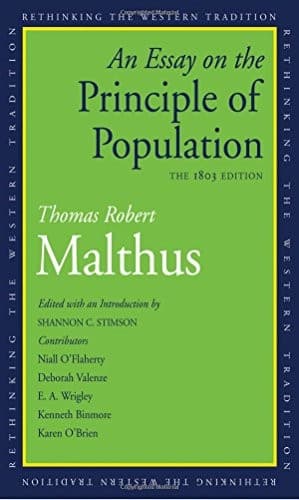
An Essay on the Principle of Population — John Shaqi
An Essay on the Principle of PopulationMalthus, T. R. (Thomas Robert)
Philosophy
An Essay on the Principle of Population
Malthus, T. R. (Thomas Robert)
Population
In the next twenty-five years, it is impossible to suppose that the
produce could be quadrupled. It would be contrary to all our knowledge
of the qualities of land. The very utmost that we can conceive, is,
that the increase in the second twenty-five years might equal the
present produce. Let us then take this for our rule, though certainly
far beyond the truth, and allow that, by great exertion, the whole
produce of the Island might be increased every twenty-five years, by a
quantity of subsistence equal to what it at present produces. The most
enthusiastic speculator cannot suppose a greater increase than this. In
a few centuries it would make every acre of land in the Island like a
garden.
Yet this ratio of increase is evidently arithmetical.
It may be fairly said, therefore, that the means of subsistence
increase in an arithmetical ratio. Let us now bring the effects of
these two ratios together.
The population of the Island is computed to be about seven millions,
and we will suppose the present produce equal to the support of such a
number. In the first twenty-five years the population would be fourteen
millions, and the food being also doubled, the means of subsistence
would be equal to this increase. In the next twenty-five years the
population would be twenty-eight millions, and the means of subsistence
only equal to the support of twenty-one millions. In the next period,
the population would be fifty-six millions, and the means of
subsistence just sufficient for half that number. And at the conclusion
of the first century the population would be one hundred and twelve
millions and the means of subsistence only equal to the support of
thirty-five millions, which would leave a population of seventy-seven
millions totally unprovided for.
A great emigration necessarily implies unhappiness of some kind or
other in the country that is deserted. For few persons will leave their
families, connections, friends, and native land, to seek a settlement
in untried foreign climes, without some strong subsisting causes of
uneasiness where they are, or the hope of some great advantages in the
place to which they are going.
But to make the argument more general and less interrupted by the
partial views of emigration, let us take the whole earth, instead of
one spot, and suppose that the restraints to population were
universally removed. If the subsistence for man that the earth affords
was to be increased every twenty-five years by a quantity equal to what
the whole world at present produces, this would allow the power of
production in the earth to be absolutely unlimited, and its ratio of
increase much greater than we can conceive that any possible exertions
of mankind could make it.
Public-domain text, read in full here on John Shaqi.
Reviews
Reviews
No reviews yet
Be the first to share your thoughts on this work.
Join the Discussion
Join the discussion
Sign in to leave a comment or review.
Sign InorCreate an account