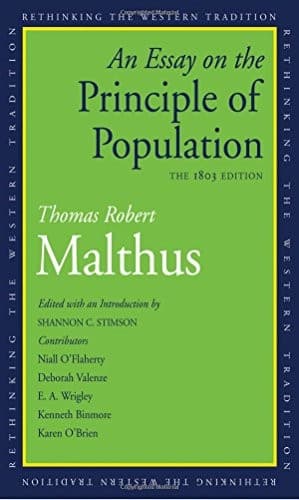
An Essay on the Principle of PopulationMalthus, T. R. (Thomas Robert)
Philosophy
An Essay on the Principle of Population
Malthus, T. R. (Thomas Robert)
Population
Taking the population of the world at any number, a thousand millions,
for instance, the human species would increase in the ratio of--1, 2,
4, 8, 16, 32, 64, 128, 256, 512, etc. and subsistence as--1, 2, 3, 4,
5, 6, 7, 8, 9, 10, etc. In two centuries and a quarter, the population
would be to the means of subsistence as 512 to 10: in three centuries
as 4096 to 13, and in two thousand years the difference would be almost
incalculable, though the produce in that time would have increased to
an immense extent.
No limits whatever are placed to the productions of the earth; they may
increase for ever and be greater than any assignable quantity, yet
still the power of population being a power of a superior order, the
increase of the human species can only be kept commensurate to the
increase of the means of subsistence by the constant operation of the
strong law of necessity acting as a check upon the greater power.
The effects of this check remain now to be considered.
Among plants and animals the view of the subject is simple. They are
all impelled by a powerful instinct to the increase of their species,
and this instinct is interrupted by no reasoning or doubts about
providing for their offspring. Wherever therefore there is liberty, the
power of increase is exerted, and the superabundant effects are
repressed afterwards by want of room and nourishment, which is common
to animals and plants, and among animals by becoming the prey of others.
The effects of this check on man are more complicated. Impelled to the
increase of his species by an equally powerful instinct, reason
interrupts his career and asks him whether he may not bring beings into
the world for whom he cannot provide the means of subsistence. In a
state of equality, this would be the simple question. In the present
state of society, other considerations occur. Will he not lower his
rank in life? Will he not subject himself to greater difficulties than
he at present feels? Will he not be obliged to labour harder? and if he
has a large family, will his utmost exertions enable him to support
them? May he not see his offspring in rags and misery, and clamouring
for bread that he cannot give them? And may he not be reduced to the
grating necessity of forfeiting his independence, and of being obliged
to the sparing hand of charity for support?
These considerations are calculated to prevent, and certainly do
prevent, a very great number in all civilized nations from pursuing the
dictate of nature in an early attachment to one woman. And this
restraint almost necessarily, though not absolutely so, produces vice.
Yet in all societies, even those that are most vicious, the tendency to
a virtuous attachment is so strong that there is a constant effort
towards an increase of population. This constant effort as constantly
tends to subject the lower classes of the society to distress and to
prevent any great permanent amelioration of their condition.
Public-domain text, read in full here on John Shaqi.
Reviews
Reviews
No reviews yet
Be the first to share your thoughts on this work.
Join the Discussion
Join the discussion
Sign in to leave a comment or review.
Sign InorCreate an account