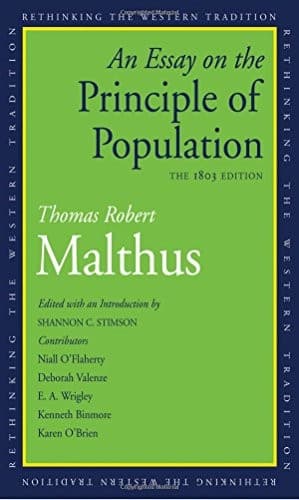
An Essay on the Principle of PopulationMalthus, T. R. (Thomas Robert)
Philosophy
An Essay on the Principle of Population
Malthus, T. R. (Thomas Robert)
Population
Dr Adam Smith has very justly observed that nations as well as
individuals grow rich by parsimony and poor by profusion, and that,
therefore, every frugal man was a friend and every spendthrift an enemy
to his country. The reason he gives is that what is saved from revenue
is always added to stock, and is therefore taken from the maintenance
of labour that is generally unproductive and employed in the
maintenance of labour that realizes itself in valuable commodities. No
observation can be more evidently just. The subject of Mr Godwin's
essay is a little similar in its first appearance, but in essence is as
distinct as possible. He considers the mischief of profusion as an
acknowledged truth, and therefore makes his comparison between the
avaricious man, and the man who spends his income. But the avaricious
man of Mr Godwin is totally a distinct character, at least with regard
to his effect upon the prosperity of the state, from the frugal man of
Dr Adam Smith. The frugal man in order to make more money saves from
his income and adds to his capital, and this capital he either employs
himself in the maintenance of productive labour, or he lends it to some
other person who will probably employ it in this way. He benefits the
state because he adds to its general capital, and because wealth
employed as capital not only sets in motion more labour than when spent
as income, but the labour is besides of a more valuable kind. But the
avaricious man of Mr Godwin locks up his wealth in a chest and sets in
motion no labour of any kind, either productive or unproductive. This
is so essential a difference that Mr Godwin's decision in his essay
appears at once as evidently false as Dr Adam Smith's position is
evidently true. It could not, indeed, but occur to Mr Godwin that some
present inconvenience might arise to the poor from thus locking up the
funds destined for the maintenance of labour. The only way, therefore,
he had of weakening this objection was to compare the two characters
chiefly with regard to their tendency to accelerate the approach of
that happy state of cultivated equality, on which he says we ought
always to fix our eyes as our polar star.
I think it has been proved in the former parts of this essay that such
a state of society is absolutely impracticable. What consequences then
are we to expect from looking to such a point as our guide and polar
star in the great sea of political discovery? Reason would teach us to
expect no other than winds perpetually adverse, constant but fruitless
toil, frequent shipwreck, and certain misery. We shall not only fail in
making the smallest real approach towards such a perfect form of
society; but by wasting our strength of mind and body, in a direction
in which it is impossible to proceed, and by the frequent distress
which we must necessarily occasion by our repeated failures, we shall
evidently impede that degree of improvement in society, which is really
attainable.
Public-domain text, read in full here on John Shaqi.
Reviews
Reviews
No reviews yet
Be the first to share your thoughts on this work.
Elsewhere in the archive
Join the Discussion
Join the discussion
Sign in to leave a comment or review.
Sign InorCreate an account