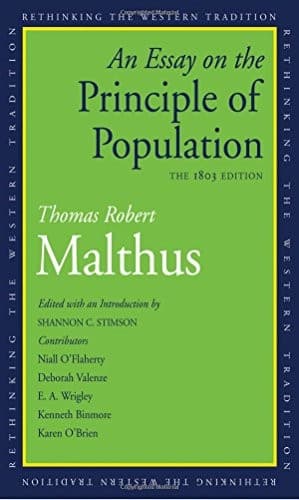
An Essay on the Principle of PopulationMalthus, T. R. (Thomas Robert)
Philosophy
An Essay on the Principle of Population
Malthus, T. R. (Thomas Robert)
Population
It has appeared that a society constituted according to Mr Godwin's
system must, from the inevitable laws of our nature, degenerate into a
class of proprietors and a class of labourers, and that the
substitution of benevolence for self-love as the moving principle of
society, instead of producing the happy effects that might be expected
from so fair a name, would cause the same pressure of want to be felt
by the whole of society, which is now felt only by a part. It is to the
established administration of property and to the apparently narrow
principle of self-love that we are indebted for all the noblest
exertions of human genius, all the finer and more delicate emotions of
the soul, for everything, indeed, that distinguishes the civilized from
the savage state; and no sufficient change has as yet taken place in
the nature of civilized man to enable us to say that he either is, or
ever will be, in a state when he may safely throw down the ladder by
which he has risen to this eminence.
If in every society that has advanced beyond the savage state, a class
of proprietors and a class of labourers must necessarily exist, it is
evident that, as labour is the only property of the class of labourers,
every thing that tends to diminish the value of this property must tend
to diminish the possession of this part of society. The only way that a
poor man has of supporting himself in independence is by the exertion
of his bodily strength. This is the only commodity he has to give in
exchange for the necessaries of life. It would hardly appear then that
you benefit him by narrowing the market for this commodity, by
decreasing the demand for labour, and lessening the value of the only
property that he possesses.
It should be observed that the principal argument of this Essay only
goes to prove the necessity of a class of proprietors, and a class of
labourers, but by no means infers that the present great inequality of
property is either necessary or useful to society. On the contrary, it
must certainly be considered as an evil, and every institution that
promotes it is essentially bad and impolitic. But whether a government
could with advantage to society actively interfere to repress
inequality of fortunes may be a matter of doubt. Perhaps the generous
system of perfect liberty adopted by Dr Adam Smith and the French
economists would be ill exchanged for any system of restraint.
Public-domain text, read in full here on John Shaqi.
Reviews
Reviews
No reviews yet
Be the first to share your thoughts on this work.
Elsewhere in the archive
Join the Discussion
Join the discussion
Sign in to leave a comment or review.
Sign InorCreate an account