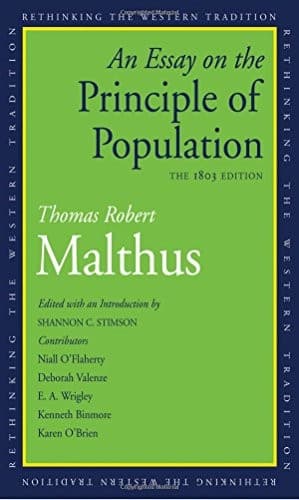
An Essay on the Principle of PopulationMalthus, T. R. (Thomas Robert)
Philosophy
An Essay on the Principle of Population
Malthus, T. R. (Thomas Robert)
Population
Mr Godwin would perhaps say that the whole system of barter and
exchange is a vile and iniquitous traffic. If you would essentially
relieve the poor man, you should take a part of his labour upon
yourself, or give him your money, without exacting so severe a return
for it. In answer to the first method proposed, it may be observed,
that even if the rich could be persuaded to assist the poor in this
way, the value of the assistance would be comparatively trifling. The
rich, though they think themselves of great importance, bear but a
small proportion in point of numbers to the poor, and would, therefore,
relieve them but of a small part of their burdens by taking a share.
Were all those that are employed in the labours of luxuries added to
the number of those employed in producing necessaries, and could these
necessary labours be amicably divided among all, each man's share might
indeed be comparatively light; but desirable as such an amicable
division would undoubtedly be, I cannot conceive any practical
principle according to which it could take place. It has been shewn,
that the spirit of benevolence, guided by the strict impartial justice
that Mr Godwin describes, would, if vigorously acted upon, depress in
want and misery the whole human race. Let us examine what would be the
consequence, if the proprietor were to retain a decent share for
himself, but to give the rest away to the poor, without exacting a task
from them in return. Not to mention the idleness and the vice that such
a proceeding, if general, would probably create in the present state of
society, and the great risk there would be, of diminishing the produce
of land, as well as the labours of luxury, another objection yet
remains.
Mr Godwin seems to have but little respect for practical principles;
but I own it appears to me, that he is a much greater benefactor to
mankind, who points out how an inferior good may be attained, than he
who merely expatiates on the deformity of the present state of society,
and the beauty of a different state, without pointing out a practical
method, that might be immediately applied, of accelerating our advances
from the one, to the other.
Public-domain text, read in full here on John Shaqi.
Reviews
Reviews
No reviews yet
Be the first to share your thoughts on this work.
Elsewhere in the archive
Join the Discussion
Join the discussion
Sign in to leave a comment or review.
Sign InorCreate an account