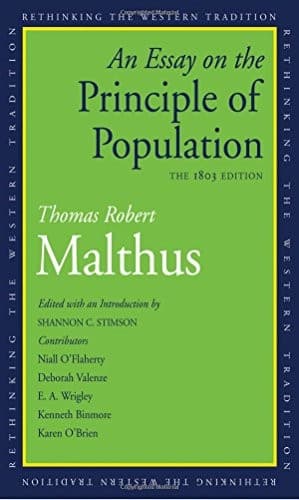
An Essay on the Principle of PopulationMalthus, T. R. (Thomas Robert)
Philosophy
An Essay on the Principle of Population
Malthus, T. R. (Thomas Robert)
Population
It has appeared that from the principle of population more will always
be in want than can be adequately supplied. The surplus of the rich man
might be sufficient for three, but four will be desirous to obtain it.
He cannot make this selection of three out of the four without
conferring a great favour on those that are the objects of his choice.
These persons must consider themselves as under a great obligation to
him and as dependent upon him for their support. The rich man would
feel his power and the poor man his dependence, and the evil effects of
these two impressions on the human heart are well known. Though I
perfectly agree with Mr Godwin therefore in the evil of hard labour,
yet I still think it a less evil, and less calculated to debase the
human mind, than dependence, and every history of man that we have ever
read places in a strong point of view the danger to which that mind is
exposed which is entrusted with constant power.
In the present state of things, and particularly when labour is in
request, the man who does a day's work for me confers full as great an
obligation upon me as I do upon him. I possess what he wants, he
possesses what I want. We make an amicable exchange. The poor man walks
erect in conscious independence; and the mind of his employer is not
vitiated by a sense of power.
Three or four hundred years ago there was undoubtedly much less labour
in England, in proportion to the population, than at present, but there
was much more dependence, and we probably should not now enjoy our
present degree of civil liberty if the poor, by the introduction of
manufactures, had not been enabled to give something in exchange for
the provisions of the great Lords, instead of being dependent upon
their bounty. Even the greatest enemies of trade and manufactures, and
I do not reckon myself a very determined friend to them, must allow
that when they were introduced into England, liberty came in their
train.
Nothing that has been said tends in the most remote degree to
undervalue the principle of benevolence. It is one of the noblest and
most godlike qualities of the human heart, generated, perhaps, slowly
and gradually from self-love, and afterwards intended to act as a
general law, whose kind office it should be, to soften the partial
deformities, to correct the asperities, and to smooth the wrinkles of
its parent: and this seems to be the analog of all nature. Perhaps
there is no one general law of nature that will not appear, to us at
least, to produce partial evil; and we frequently observe at the same
time, some bountiful provision which, acting as another general law,
corrects the inequalities of the first.
Public-domain text, read in full here on John Shaqi.
Reviews
Reviews
No reviews yet
Be the first to share your thoughts on this work.
Elsewhere in the archive
Join the Discussion
Join the discussion
Sign in to leave a comment or review.
Sign InorCreate an account