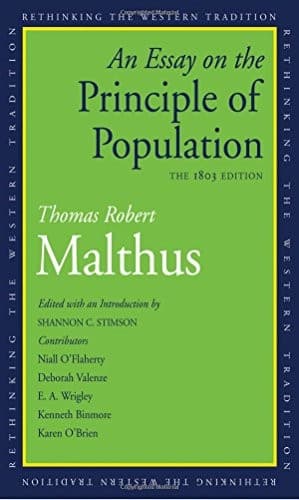
An Essay on the Principle of PopulationMalthus, T. R. (Thomas Robert)
Philosophy
An Essay on the Principle of Population
Malthus, T. R. (Thomas Robert)
Population
The proper office of benevolence is to soften the partial evils arising
from self-love, but it can never be substituted in its place. If no man
were to allow himself to act till he had completely determined that the
action he was about to perform was more conducive than any other to the
general good, the most enlightened minds would hesitate in perplexity
and amazement; and the unenlightened would be continually committing
the grossest mistakes.
As Mr Godwin, therefore, has not laid down any practical principle
according to which the necessary labours of agriculture might be
amicably shared among the whole class of labourers, by general
invectives against employing the poor he appears to pursue an
unattainable good through much present evil. For if every man who
employs the poor ought to be considered as their enemy, and as adding
to the weight of their oppressions, and if the miser is for this reason
to be preferred to the man who spends his income, it follows that any
number of men who now spend their incomes might, to the advantage of
society, be converted into misers. Suppose then that a hundred thousand
persons who now employ ten men each were to lock up their wealth from
general use, it is evident, that a million of working men of different
kinds would be completely thrown out of all employment. The extensive
misery that such an event would produce in the present state of society
Mr Godwin himself could hardly refuse to acknowledge, and I question
whether he might not find some difficulty in proving that a conduct of
this kind tended more than the conduct of those who spend their incomes
to 'place human beings in the condition in which they ought to be
placed.' But Mr Godwin says that the miser really locks up nothing,
that the point has not been rightly understood, and that the true
development and definition of the nature of wealth have not been
applied to illustrate it. Having defined therefore wealth, very justly,
to be the commodities raised and fostered by human labour, he observes
that the miser locks up neither corn, nor oxen, nor clothes, nor
houses. Undoubtedly he does not really lock up these articles, but he
locks up the power of producing them, which is virtually the same.
These things are certainly used and consumed by his contemporaries, as
truly, and to as great an extent, as if he were a beggar; but not to as
great an extent as if he had employed his wealth in turning up more
land, in breeding more oxen, in employing more tailors, and in building
more houses. But supposing, for a moment, that the conduct of the miser
did not tend to check any really useful produce, how are all those who
are thrown out of employment to obtain patents which they may shew in
order to be awarded a proper share of the food and raiment produced by
the society? This is the unconquerable difficulty.
Public-domain text, read in full here on John Shaqi.
Reviews
Reviews
No reviews yet
Be the first to share your thoughts on this work.
Elsewhere in the archive
Join the Discussion
Join the discussion
Sign in to leave a comment or review.
Sign InorCreate an account