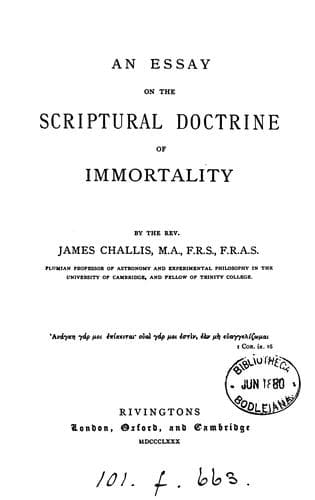
An Essay on the Scriptural Doctrine of ImmortalityChallis, James
Religion
An Essay on the Scriptural Doctrine of Immortality
Challis, James
Immortality
Produced by Al Haines
AN ESSAY
ON THE
SCRIPTURAL DOCTRINE
OF
IMMORTALITY
BY THE REV.
JAMES CHALLIS, M.A., F.R.S., F.R.A.S.
PLUMIAN PROFESSOR OF ASTRONOMY AND EXPERIMENTAL PHILOSOPHY IN THE
UNIVERSITY OF CAMBRIDGE, AND FELLOW OF TRINITY COLLEGE.
_Anagke gar moi epikeitai ouai gar moi estin, ean me euaggelzumai
--1 Cor. ix. 16
RIVINGTONS
London, Oxford, and Cambridge
MDCCCLXXX
RIVINGTONS
London . . . . . . _Waterloo Place_
Oxford . . . . . . _Magdalen Street_
Cambridge . . . . _Trinity Street_
[_All rights reserved_]
{1}
AN ESSAY
ON THE
SCRIPTURAL DOCTRINE OF IMMORTALITY.
Considering that under the existing conditions of humanity, disease,
and decay, and death abound on every side, it is surprising that the
word "immortality" obtained a place in systems of philosophy, the
authors of which must be supposed to have been unacquainted with divine
revelation. It is not surprising that in the absence of such aid the
belief of immortality should not have been firmly held, or that by some
philosophers it should have been expressly disavowed. Even in the
Canonical Scriptures, the words "immortal" and "immortality" occur only
in the Epistles of the Apostle Paul, and consequently not till "life
and immortality had been brought to light through the Gospel." It is a
remarkable circumstance that these words are met with more frequently
in the Apocryphal Books, 2 Esdras, Wisdom of Solomon, and
Ecclesiasticus, than in the Canonical Scriptures. The {2} explanation
of the apparent silence of the Scriptures, especially those of the Old
Testament, on so essential a doctrine, will, I think, be found to be
given by the course of argument adopted in this essay.
It may, further, be noticed that, according to philosophical dogma not
derived from the teaching of Scripture, immortality is regarded as a
principle, or innate quality, in virtue of which the human soul is
exempt from the experience of death or annihilation. On this account
Greek and Roman philosophers speak of "the immortality of _the soul_,"
and even in the present day the same terms are used, the soul being
regarded as _per se_ immortal. But neither in the Scriptures, nor in
the Apocrypha, is "immortality" qualified by the adjunct "of the soul;"
the reason for which may be that since death, as far as our senses
inform us, is an _objective_ reality, the writers judged that mortality
and freedom from mortality could only be predicated of _body_. It
must, however, be taken into account that according to the doctrine of
Scripture there is "a spiritual body" as well as "a natural body," so
that while the natural body is, as we know, subject to the law of
death, it may be true that the spiritual body is capable of
immortality. This point will be farther discussed in the course of the
essay.
Public-domain text, read in full here on John Shaqi.
Reviews
Reviews
No reviews yet
Be the first to share your thoughts on this work.
Join the Discussion
Join the discussion
Sign in to leave a comment or review.
Sign InorCreate an account