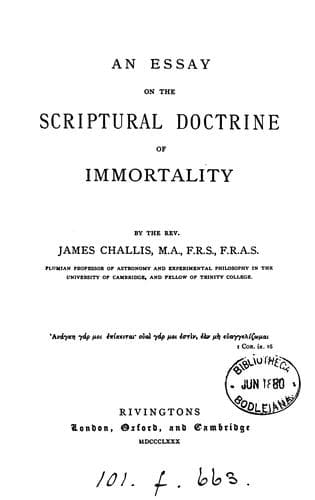
An Essay on the Scriptural Doctrine of Immortality — John Shaqi
An Essay on the Scriptural Doctrine of ImmortalityChallis, James
Religion
An Essay on the Scriptural Doctrine of Immortality
Challis, James
Immortality
To account for the absence of any direct announcement of man's
immortality in the Old Testament, and for its being sparingly mentioned
in the New {3} Testament, the following argument seems legitimate and
sufficient. These Scriptures, as already intimated, give no
countenance to the idea that the soul of man possesses any innate
principle of immortality; on the contrary, they reveal immortality by
revealing _the means_ by which the spirit of man is _made_ immortal.
As, according to natural science, the external world, both the animate
part and the inanimate, has become such as we now perceive it to be by
processes of generation and development, so there is reason from
Scripture to say that a spiritual world is being created in an
analogous manner, and that to this creation all other creations are
subordinate and contributory. Moreover, we, the subjects of this
creation, are so constituted that we are conscious of, and can
ourselves take cognizance of, the means by which it is effected. These
considerations may be applied to account for the mode in which
immortality is treated of in the Bible. It concerns us, above all
things, to discern and feel the operations whereby our spirits are
formed both intellectually and morally for an immortal existence; and,
accordingly, Scripture is full of instruction, addressed both to the
understanding and the heart, concerning those means. Thus, although
the final effect is not directly named till the scheme of the spiritual
creation is completely unfolded, it is yet true that the whole of the
Scriptures from beginning to end has relation to man's immortality.
{4}
Not only did the philosophy of Greece and Rome fail to substantiate the
reality of an immortal existence; other philosophical systems, as well
the mystical conceptions of Eastern nations, as the metaphysical
speculations of modern Europe, have equally failed to arrive at
certainty respecting this verity. Now, it will be found, I think, to
be established by the argument of this essay, that in all these
instances the cause of failure is the same. The doctrine cannot, in
fact, be understood and believed without an understanding of the means
by which the immortal spirit is _formed_, and the ascertainment of
those means is beyond the power of unaided human intelligence.
Although the evidences of an immortal destiny may be in us and around
us, they cannot be discerned apart from enlightenment by a divine
revelation as to the purpose and end of the whole creation.
Public-domain text, read in full here on John Shaqi.
Reviews
Reviews
No reviews yet
Be the first to share your thoughts on this work.
Join the Discussion
Join the discussion
Sign in to leave a comment or review.
Sign InorCreate an account