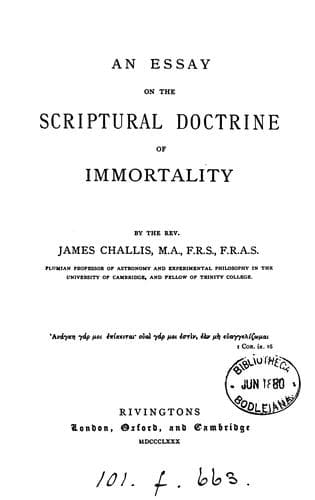
An Essay on the Scriptural Doctrine of Immortality — John Shaqi
An Essay on the Scriptural Doctrine of ImmortalityChallis, James
Religion
An Essay on the Scriptural Doctrine of Immortality
Challis, James
Immortality
We have argued above that the patriarchs Noah {28} and Abraham
testified their belief and acceptance of the covenant of life by
sacrifice. But in the patriarchal times the only surety for the
fulfilment of the promise was the direct word of God. With the
exception of what is said of Melchisedek, who typified a High Priest to
come, no mention is made of the mediation of priests till the
priesthood of Aaron was regularly constituted. From that time the
priest was mediator between God and the people, and in virtue of his
office gave assurance of the fulfilment of the covenant to those who,
by offering clean animals for sacrifice, signified their acceptance of
its conditions. The priest gave such assurance by mediatorially
receiving the offerings, and representing, by sprinkling the blood of
the slain animals, _the purifying effect of the suffering of death_.
After the ordinances of the law had been instituted, Moses said to the
people, "I have set before you life and death: choose life" (Deut. xxx.
19). Seeing that no one can escape the death which is the termination
of the present life, this choice between life and death necessarily
refers to the covenanted life, the fulfilment of the conditions of
which secures from death in the world to come. The author of the
Apocryphal Book 2 Esdras, who was wiser, I think, than the author of
"The Divine Legation of Moses," has shown that he so understood the
passage; for after saying (vii. 48, 44), "The day of doom shall be the
end of this time, and the {29} beginning of the immortality for to
come, wherein corruption is past, intemperance is at an end, infidelity
is cut off, righteousness is grown, and truth is sprung up," he adds
(in _v._ 59) with reference to this description of the life to come,
"This is the life whereof Moses spake unto the people while he lived,
saying, Choose thee life, that thou mayest live."
Public-domain text, read in full here on John Shaqi.
Reviews
Reviews
No reviews yet
Be the first to share your thoughts on this work.
Join the Discussion
Join the discussion
Sign in to leave a comment or review.
Sign InorCreate an account