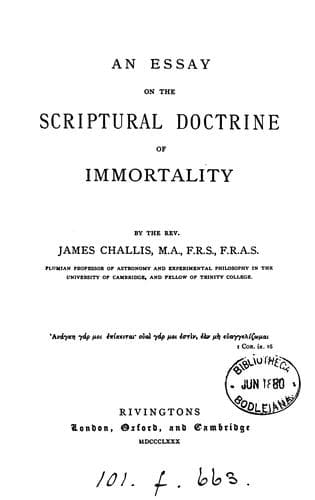
An Essay on the Scriptural Doctrine of Immortality — John Shaqi
An Essay on the Scriptural Doctrine of ImmortalityChallis, James
Religion
An Essay on the Scriptural Doctrine of Immortality
Challis, James
Immortality
Sacrifice remained the chief symbol of religious faith up to the time
of that great sacrifice of the Son of God, the acceptance of which by
the Father sealed the covenant of everlasting life, and made all other
sureties sure. The ground of assurance lies in the fact that Jesus
Christ in his life and death went through all the experience whereby
_our_ spirits are formed for immortality. "He learned obedience by the
things that he suffered" (Heb. v. 8). He was made perfect "through
sufferings" (Heb. ii. 10). "He made him to be sin (_hamartian_;
compare Gal. iii. 13) for us, who knew no sin, that we might be made
the righteousness of God in Him" (2 Cor. v. 21). Joining with these
passages that remarkable one in which Christ is spoken of as "a priest
who is made according to the power of an indissoluble (_akatalytou_)
life" (Heb. vii. 16), it is evident that our community with him in
suffering, in death, and, as we have reason to hope, in resurrection,
is ample surety to us for the fulfilment of the covenant of
immortality. For as death is the dissolution of life, indissoluble
{30} life means exemption from death, and is, therefore, identical with
immortality.
That suffering in the flesh is efficacious, as is argued in the
foregoing doctrine, towards doing away with sin, may be maintained on
the authority both of St. Paul and St. Peter, the former apostle having
said, "He that is dead has been justified from sin" (Rom. vi. 7), and
the other, "He that has suffered in the flesh has ceased from sin" (1
Peter iv. 1). But here it is particularly to be noted that this effect
is not produced upon _all_ who suffer in the flesh. These apostles are
speaking of such as have faith; and it is only when suffering is
accompanied by a faith which apprehends the covenant of life, and
especially lays hold of the surety for its fulfilment given by the
suffering and death of the Son of God, that it avails to free from sin.
The elect, who through the grace of God have such faith, are drawn by
the perfect love, and the _sympathy_ in its strictest sense, which were
manifested by the obedience unto death of Jesus Christ, to follow the
example of his obedience, and thereby to attain to righteousness. By
this reasoning it is shown, _but only so far as regards the elect_,
that "the many are made righteous by the obedience of Christ." It will
in the sequel be argued that the death of Christ has another aspect and
a wider effect.
Public-domain text, read in full here on John Shaqi.
Reviews
Reviews
No reviews yet
Be the first to share your thoughts on this work.
Join the Discussion
Join the discussion
Sign in to leave a comment or review.
Sign InorCreate an account