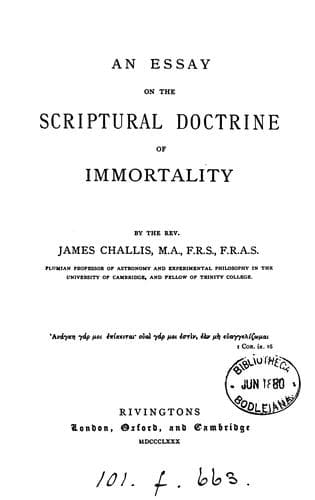
An Essay on the Scriptural Doctrine of ImmortalityChallis, James
Religion
An Essay on the Scriptural Doctrine of Immortality
Challis, James
Immortality
After having thus considered what the Scriptures say concerning
_death_, we have next to inquire what they reveal concerning
_resurrection_. As preliminary to this inquiry, it may be remarked
that the foregoing arguments relative to Christ's partaking with us in
death, are such as point directly to the conclusion that {36} we shall
participate with him in resurrection. In St. Paul's teaching (1 Cor.
xv. 12-19) Christ's resurrection and the resurrection of the dead are
events so necessarily related that, "if the dead rise not, Christ was
not raised up." But the fact of Christ's resurrection was
substantiated by so many witnesses, who saw him alive after his death,
that we may with certainty infer, according to this doctrine, that the
dead will rise. It is, however, to be observed that the argument of
the apostle in the passage just quoted is expressly addressed to those
who have faith and knowledge, and cannot be adduced in proof of the
doctrine of the resurrection of all men. For evidence as to the truth
of this doctrine recourse must be had to other parts of Scripture.
For the present purpose it will suffice to cite two remarkable sayings
of our Lord, recorded in St. John's Gospel. He first says, "The hour
is coming, and now is, when the dead shall hear the voice of the Son of
God: and they that hear shall live" (John v. 25); and then (in _vv._ 28
and 29 of the same chapter) he says, "The hour is coming in which all
that are in their graves shall hear his voice, and shall come forth;
they that have done good, unto the resurrection of life; and they that
have done evil, unto the resurrection of judgment" (_kriseos_). The
first passage refers to a _partial_ resurrection, inasmuch as it makes
mention of those only who shall hear the voice of the Son of {37} God,
and hearing shall live; whereas the other passage asserts that _all_
who are in sepulchres (_mnemeiois_) shall hear his voice, and divides
these into two classes--those that have done good, who rise to _live_
(the class just before mentioned), and those that have done evil, who
rise to be _judged_. The assertion in _vv._ 28 and 29 is, accordingly,
a revelation respecting the resurrection of all the dead, and is to be
taken as comprehensive of the other; so that the class that will
partake of "the resurrection of life" are the same as those of whom it
is said in the first passage that they will hear the voice of the Son
of God and will _live_. As far as regards the distinction into two
classes, this doctrine agrees with that preached by St. Paul, where he
affirms that his unbelieving countrymen "themselves allowed that there
would be a resurrection of the dead, both of the just and the unjust"
(Acts xxiv. 15). It may here be remarked that it is not necessary to
infer from its being said in John v. 28, 29, that "all that are in
their graves shall hear his voice and come forth," that all will rise
_simultaneously_. Rather the separate mention in _v._ 25 of those that
Public-domain text, read in full here on John Shaqi.
Reviews
Reviews
No reviews yet
Be the first to share your thoughts on this work.
Join the Discussion
Join the discussion
Sign in to leave a comment or review.
Sign InorCreate an account