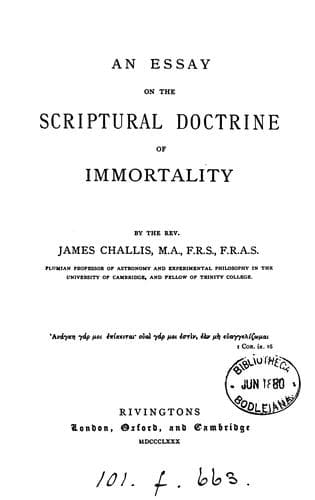
An Essay on the Scriptural Doctrine of Immortality — John Shaqi
An Essay on the Scriptural Doctrine of ImmortalityChallis, James
Religion
An Essay on the Scriptural Doctrine of Immortality
Challis, James
Immortality
But why did Christ say, "This _is_ my body," "This _is_ my blood"? The
answer to this question may be given at once by pointing to a rule in
Scriptural teaching, according to which the symbol and the thing
symbolized are expressed in _identical_ terms. {34} The Bible must
have been read to little purpose by those who have not discovered that
this characteristic pervades all parts both of the Old and the New
Testament. On this principle, when speaking to the Jews, our Lord made
no distinction between his own body and the visible temple at
Jerusalem, just because his body was the proper habitation of the Holy
Spirit antecedently to, and comprehensively of, the dwelling of the
Spirit in any temple made with hands. St. Paul also employs like
teaching where he says, "They are not all Israel that are of Israel"
(Rom. ix. 6), the first "Israel" meaning God's elect of all nations and
times, and the other the Jewish people, by whom the elect are typified.
The rationale of this mode of teaching appears to be, that we could not
speak, or even think, of abstract verities, such as that Jesus Christ
is to us the author of life, and strength, and joy, without perceptions
and feelings antecedently derived from external realities; and the more
closely abstractions are viewed by the intervention of their necessary
objective antecedents, the more exact and effective will be our
knowledge. I venture here to express the opinion that all the
contention and diversity of views that have arisen about
Transubstantiation and the Real Presence are referable to the
non-recognition of the above-mentioned principle of Scriptural teaching
by symbols, and generally to an inability to understand and rightly
interpret the {35} concrete and symbolic language of Scripture. Defect
of knowledge in this respect has given occasion to many errors. With
regard to the doctrine of the Sacrament of the Lord's Supper, I am of
opinion that the above-mentioned dogmas, and the forms of worship
connected with them, which appear to be rightly designated as
_superstitious_, have had the effect of very much keeping out of view
the relation of that ordinance to the _covenant_ which, through the
death of Jesus Christ, makes immortality sure. Perhaps it should
rather be said that the superstitious practices give evidence that "the
blood of the new covenant" is not understood.
From the preceding discussion I draw the conclusion that our Lord, in
saying of the wine, "This is my blood of the New Testament," expressed
the doctrine that his blood (signifying his death) is both the _pledge_
and the means, through faith, of partaking of the joy (signified by the
wine) of a new and ever-lasting life. The Testament is new because it
contains the promise of a future inheritance under better sureties than
those of the old covenant of the Law.
Public-domain text, read in full here on John Shaqi.
Reviews
Reviews
No reviews yet
Be the first to share your thoughts on this work.
Join the Discussion
Join the discussion
Sign in to leave a comment or review.
Sign InorCreate an account