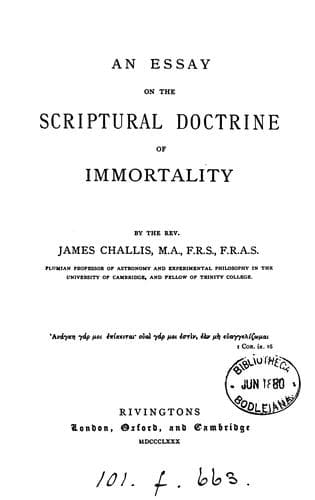
An Essay on the Scriptural Doctrine of Immortality — John Shaqi
An Essay on the Scriptural Doctrine of ImmortalityChallis, James
Religion
An Essay on the Scriptural Doctrine of Immortality
Challis, James
Immortality
It is, besides, said of these chosen ones that they "lived and reigned
with Christ a thousand years," but that "the rest of the dead lived not
till the thousand years were finished." It would thus appear that a
definite interval of long duration is interposed between the
resurrection of the just and the unjust. It is also to be particularly
noticed that the seer, speaking of what pertains to that interval of a
thousand years during which the spirit of evil is "bound," says that he
"saw thrones, and they sat upon them, and judgment was given to them"
(Rev. xx. 4). This must refer to the judgment undergone by those who
have part in the _first_ resurrection, because the rest of the dead do
not rise to be judged till the thousand years are ended. As to the
elect being judged, the teaching of St. Paul is very explicit, where he
says, identifying himself with the general company of the faithful, "We
must all appear before the judgment-seat of Christ; that every one may
receive the things done through the body, according to what he hath
done, whether good or bad" (2 Cor. v. 10. So also Rom. xiv. 10). It
is not expressly said in the passage above quoted who they are who sat
on thrones and had judgment given to them; but the information is
supplied in Matt. xix. 28, where we read, "Jesus said to them [that is,
as the context shows, to Peter and the other apostles], Verily I say to
you, that ye who have followed me, in the regeneration when the Son of
man shall sit on the {40} throne of his glory, ye also shall sit on
twelve thrones judging the twelve tribes of Israel." A like
revelation, addressed exclusively to the apostles, is given in Luke
xxii. 28-80. "The twelve tribes of Israel" is the symbolic designation
of the elect--those that are sealed (see Rev. vii. 3-8).
It must now be taken into account that the experience and the deeds of
_the present life_ alone determine whether any individual is or is not
of the number of the elect. Those only who by the favour of God are
justified in this life by works done through faith are reckoned among
"the just" who partake of the first resurrection. But Scripture
nowhere asserts that their spiritual state differs at their
resurrection from what it was at the time of their death; rather, it
negatives this assumption by describing their state in the interval as
that of "_sleep_." Consequently, not being yet "made perfect," they
have need to pass through the judgment just spoken of (compare 1 Cor.
iii. 11-15), in order that by the completion of their _spiritual
creation_ they might be made meet for immortality. To them, although
there is judgment, there is no "_condemnation_," and, therefore, no
"second death." Such, it seems to me, is the Scriptural doctrine of
immortality, as far as regards _the elect_.
Public-domain text, read in full here on John Shaqi.
Reviews
Reviews
No reviews yet
Be the first to share your thoughts on this work.
Join the Discussion
Join the discussion
Sign in to leave a comment or review.
Sign InorCreate an account