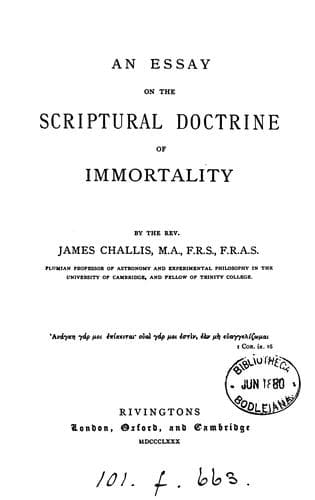
An Essay on the Scriptural Doctrine of Immortality — John Shaqi
An Essay on the Scriptural Doctrine of ImmortalityChallis, James
Religion
An Essay on the Scriptural Doctrine of Immortality
Challis, James
Immortality
Before proceeding to speak of the judgment of the whole world, it will
be appropriate to consider here what judgment is abstractedly, and what
are its {41} purpose and effect. These questions can only be answered
by means of what is matter of human experience, and in terms derived
therefrom. Now we all know that kings, judges, and magistrates
administer justice and judgment for the purpose of making righteousness
and truth prevail, and that for the same end they inflict punishment on
the guilty. Whatever is this is judgment, and what is not this is not
judgment. The portion of the Scriptures which speaks in plainest terms
of the object and effect of judgment is, perhaps, that contained in
Psalms xcvi., xcvii., xcviii., and xcix. If the words of these Psalms
do not refer to the judgment that is to come upon the earth and the
whole world in the future age, they will require to be taken in a
non-natural sense. But such a sense is here inadmissible, because
consistently with what may be inferred, as said above, from _human
experience_ respecting judgment, namely, that its purpose is to cause
righteousness and truth to prevail, this Scripture declares in terms
expressive of the highest joy and exultation that for this end the
world is judged.
Let us, therefore, now inquire what Scripture reveals respecting the
judgment and immortality of the rest of mankind--those who are not
numbered among the elect. First, it is clearly implied in Rev. xx. 5,
that they live again at the end of the thousand years. Next, as we
have already inferred from the words of {42} Christ recorded in John v.
29, they rise to be _judged_. If, as we have argued, it is needful
that even the elect should be judged, much rather must judgment
overtake the unbelieving and the unrighteous? We are, moreover,
expressly told who is to be the righteous Judge: "The Father hath
committed all judgment to the Son" (John v. 22). The sinners who,
acting "through ignorance" as agents of Satan, arraigned, condemned,
and put to death the blameless Son of God, were not alone guilty,
inasmuch as it was appointed that they should make manifest and
consummate the wickedness that reigns in the heart of the collective
world. For this reason Jesus Christ, in fulfilment of a just
retribution, is ordained to be Judge of all the world, and of Satan
also.
Public-domain text, read in full here on John Shaqi.
Reviews
Reviews
No reviews yet
Be the first to share your thoughts on this work.
Join the Discussion
Join the discussion
Sign in to leave a comment or review.
Sign InorCreate an account