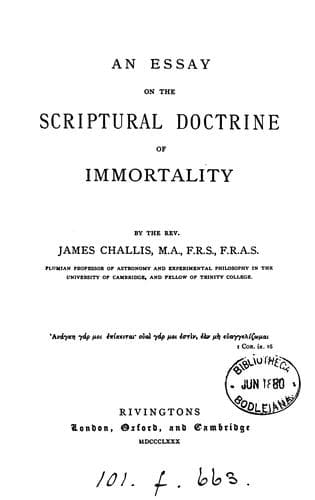
An Essay on the Scriptural Doctrine of ImmortalityChallis, James
Religion
An Essay on the Scriptural Doctrine of Immortality
Challis, James
Immortality
Equally remarkable is another revelation, which tells us that the
elect, the one hundred and forty-four thousand who have been made
perfect by the experience they have gone through in the thousand years
of the first resurrection, are joined with the Son of God in the
execution of the general judgment. In Rev. xix. 14, it is said that
"the armies in heaven followed him upon white horses, clothed in fine
linen, white and clean." This clothing proves that the attendant army
consisted of the saints made perfect in righteousness, as will be
evident by comparing _vv._ 7 and 8 of the same chapter. In _v._ 15 it
is asserted respecting "The Word of God," that "he shall rule the
nations with a rod of iron;" and he says himself, speaking of his
faithful followers, "To him that overcometh and keepeth my works unto
the end will I give power over the nations; and he shall rule them with
a rod of iron" (Rev. ii. 26, 27). Also we have in Psalm cxlix. 6-9,
"Let a two-edged sword be in their hand, to execute vengeance upon the
nations, punishments upon the peoples; to bind their kings with chains,
and their rulers with fetters of iron; to execute upon them the
judgment written: this honour have all His saints." Moreover, St. Paul
writes to the Corinthians: "Do ye not know that the saints shall judge
the world?" "Know ye not that we shall judge angels?" In short, the
doctrine of Scripture on this prerogative of the saints is very
explicit.
{45}
Again, it is uniformly affirmed in Scripture that every one will be
judged "according to his works." Of course, "words" are included in
"works;" for our Lord said expressly, "Every idle word that men shall
speak, they shall give account thereof in the day of judgment; for by
thy words thou shalt be justified, and by thy words thou shalt be
condemned" (Matt. xii. 86, 87). It would seem that the judgment, as
being conducted by _external_ means, takes account of human _thoughts_
only so far as their consequences are manifested by overt deeds and
spoken words. It is not the less true, according to the doctrine of
the Lord himself (in Mark iv. 22, and Luke viii. 17), that in the day
of judgment all secret and hidden things will be revealed. The words
in St. Mark, "neither was anything kept secret but in order that
(_hina_) it should come abroad," seem expressly to indicate the
relation in which things hidden in the present age stand to the
revelations of that day. St. Paul also writes to the Romans, speaking
of them who have not received the law by direct communication: "They
show the work of the law written in their hearts, their conscience
bearing them witness, and their thoughts, one with another, accusing,
or also excusing, in the day when God shall judge the secrets of men,
according to my gospel, through Jesus Christ" (Rom. ii. 15, 16).
(This, I think, should be the translation of the passage.) It may be
noticed that {46} here again "gospel" is mentioned in connection with
"judgment."
Public-domain text, read in full here on John Shaqi.
Reviews
Reviews
No reviews yet
Be the first to share your thoughts on this work.
Join the Discussion
Join the discussion
Sign in to leave a comment or review.
Sign InorCreate an account