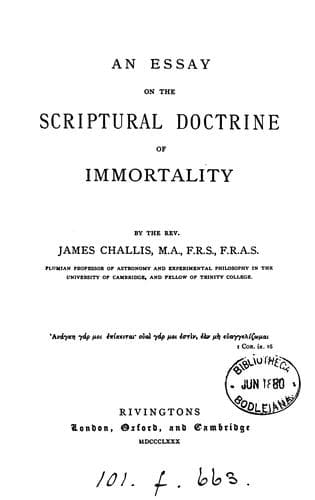
An Essay on the Scriptural Doctrine of ImmortalityChallis, James
Religion
An Essay on the Scriptural Doctrine of Immortality
Challis, James
Immortality
Now, the very terms, "judgment according to works," imply that the
works brought into judgment are not all equally bad, and that there may
be both "good and bad;" which also may be inferred from the passage
just quoted from the Epistle to the Romans. In fact, it is not too
much to assume that all the deeds and experience of the present life
are contributory in different ways to the final purpose of the
judgment. We have already argued, in accordance with what is said in 2
Cor. v. 10, that the saints will be judged according to their works,
and from 1 Cor. iii. 11-15, we learn that their works will be tried by
fire, but they themselves will be saved, "yet so as by fire." We have
now to enter upon the important inquiry as to whether Scripture reveals
an analogous dispensation with respect to the rest of mankind.
Hard as it may be for us to conceive by what means the deeds and
experience of all men, the living and the dead, will be brought under
review in the day of judgment, that so it will be is undoubtedly the
teaching of Scripture. Our understanding of this wonderful event may
perhaps be assisted by taking into account what St. Paul said to the
Athenians: "In Him we live, and move, and have our being;" whence it
may be inferred that all our works and {47} words, and even feelings
and thoughts, are known to God. With reference to this question, it
would, I think, be legitimate to call to our aid the knowledge of the
external creation, which has been so largely extended in the present
day. After long attention given to the acquisition of such knowledge,
I seem to see that it points to the conclusion that all the forces of
nature are resident in a universal aetherial medium, extending through
all space, and pervading all visible and tangible substances, by the
intervention of which all power is exerted, whether it be by the
immediate will of God, or mediately, by that of angels or of men. (I
assume that there can be no exertion of power apart from the will and
consciousness of an agent.) Consequently the Spirit of the Universe
must be cognizant of every exertion of power and of its effects. To
this consideration another of peculiar significance is to be added.
The faculty which we possess to a limited extent, depending on bodily
conditions and organization, of _remembering_ the consequences of
exerted power, whether as operating ourselves, or being operated upon,
must be conceived of as pertaining, without any limitation, to the
Creator of the aetherial substance and the Source of all power. In
this manner it seems possible to understand how all actions and all
events may be written down (speaking metaphorically) in the Book of
God's _remembrance_, and so be brought into judgment.
{48}
Public-domain text, read in full here on John Shaqi.
Reviews
Reviews
No reviews yet
Be the first to share your thoughts on this work.
Join the Discussion
Join the discussion
Sign in to leave a comment or review.
Sign InorCreate an account