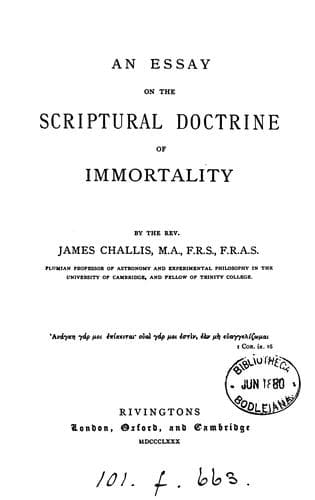
An Essay on the Scriptural Doctrine of ImmortalityChallis, James
Religion
An Essay on the Scriptural Doctrine of Immortality
Challis, James
Immortality
But in the passage before us we have "smoke of torment," of which smoke
it is said that it "ascends up for ever and ever," signifying, it would
seem, the perpetuity of the _effect_ of the torment. This
interpretation accordingly agrees with that previously given (p. 61)
relative to "the lake of fire burning with brimstone." There is,
however, this difference to be noted, that whereas the present passage
relates especially to the effect of the _pain and torment_ attendant
upon the _process_ of being judged, the other speaks of the effect of
the second _death_ to {66} which the wicked, after being tried by the
judgment, are condemned.
The portion of Scripture contained in Matt. xxv. 31-46, gives,
concerning the awards to be respectively adjudged to the righteous and
unrighteous, and the final consequences of the judgment, certain
revelations, symbolically expressed, which are made by the Lord
himself, the future Judge. In order to complete the argument from
Scripture respecting the effect of judgment, we must endeavour to
interpret these revelations. "When the Son of man shall come in his
glory, and all the holy angels with him, he will sit on the throne of
his glory: and all nations will be gathered before him: and he will
separate them one from another, as a shepherd separates the sheep from
the goats; and he will place the sheep on his right hand, and the goats
on his left" (_vv._ 31-33). We are thus told that all of all nations
will come into the presence of the Judge, and that he will separate
them into two portions, as distinct the one from the other as sheep are
from goats. From what is said farther on we gather that one portion
are "the just" (_oi dikaioi_, _v._ 37), and the other the unjust; but
no mention is made of a particular process of separation. Consequently
there is nothing here which contradicts the conclusion before arrived
at (p. 38), that the just are separated from the unjust by partaking of
the first resurrection; rather, that conclusion is in {67} accordance
with this revelation respecting the place of honour "on the right hand"
being assigned to the just, and their being prepared to receive it when
the whole assembly, just and unjust, are gathered together before the
Judge. In _v._ 34, as also in _v._ 40, the Judge is called "the King"
(_ho Basileus_), forasmuch as he is "the faithful and true" One, who
"in righteousness judges and makes war," and to whom belongs in a
special manner the title of "King of kings and Lord of lords" (see Rev.
xix. 11, 16).
Public-domain text, read in full here on John Shaqi.
Reviews
Reviews
No reviews yet
Be the first to share your thoughts on this work.
Join the Discussion
Join the discussion
Sign in to leave a comment or review.
Sign InorCreate an account