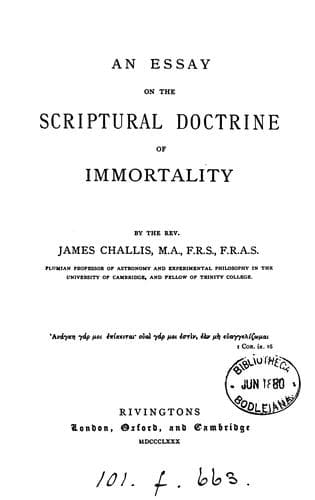
An Essay on the Scriptural Doctrine of ImmortalityChallis, James
Religion
An Essay on the Scriptural Doctrine of Immortality
Challis, James
Immortality
We have next to consider the statements of the grounds on which the
awards are made, which are very remarkable. "Then shall the King say
to them on his right hand, Come, ye blessed of my Father, inherit the
kingdom prepared for you from the foundation of the world. For I was
hungry, and ye gave me meat; I was thirsty, and ye gave me drink; I was
a stranger, and ye took me in; naked, and ye clothed me; I was sick,
and ye visited me; I was in prison, and ye came to me. Then shall the
righteous answer him, saying, Lord, when saw we thee hungry, and fed
thee? or thirsty, and gave thee drink? When saw we thee a stranger,
and took thee in? or naked, and clothed thee? Or when saw we thee
sick, or in prison, and came unto thee? And the King shall answer and
say to them, Verily I say to you, Inasmuch as ye have done it unto one
of the least of these my brethren, ye have done it unto me" {68} (_vv._
84-40). What is chiefly noteworthy in these words is, that the Judge
identifies himself with suffering humanity, and accounts as "brethren"
even "the least" of those that suffer, having, when he "dwelt among
us," participated in the toils and afflictions to which sinful man is
subject (although "in him was no sin)," and submitted in the end to the
shame and pain of dying on the cross, although he had shown by his
miracles that he had power over death and all the ills of humanity. As
is written in Isaiah liii. 4, "He hath borne _our_ griefs and carried
_our_ sorrows." This the Son of God voluntarily took upon himself out
of love and compassion towards us, knowing that, by ordinance of his
Father, the Creator of spirits, "we must through many tribulations
enter into the kingdom of God" (Acts xiv. 22), and be made heirs of
immortality, and that consequently we had need of such assurance of
obtaining the appointed inheritance as that which is given by his
partaking with us of life, death, and resurrection (see what is said on
this part of the subject in p. 29). Besides this, the sympathy of
Jesus Christ with human suffering, which was also shown by his miracles
of healing, is specially a reason for giving _practical_ proof, by acts
of benevolence and mercy towards our fellow men, that we partake of the
same spirit. It is with reference to such _outward_ evidence of faith
and righteousness, that the decision of the Judge, given {69} in the
passage above quoted, is pronounced. It seems, too, from the questions
put to the Judge by the company of the righteous, and the answer they
received, that their acts of kindness and mercy, done in humility and
faith, were accepted by the Judge, out of his sympathy and community
with the sufferers, as done to himself, although the doers had not had
previous knowledge or expectation that their good deeds would be so
accepted.
Public-domain text, read in full here on John Shaqi.
Reviews
Reviews
No reviews yet
Be the first to share your thoughts on this work.
Join the Discussion
Join the discussion
Sign in to leave a comment or review.
Sign InorCreate an account