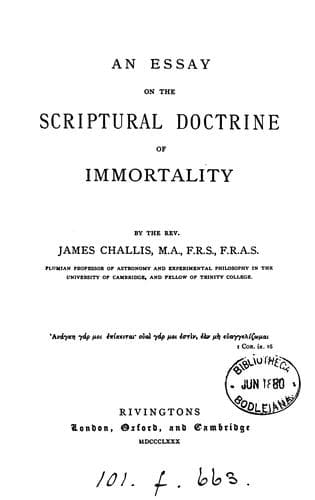
An Essay on the Scriptural Doctrine of Immortality — John Shaqi
An Essay on the Scriptural Doctrine of ImmortalityChallis, James
Religion
An Essay on the Scriptural Doctrine of Immortality
Challis, James
Immortality
Commencing now, after the foregoing preliminaries, the general
argument, I remark, in the first place, that since, as matter of fact,
all men die, they cannot partake of immortality unless they are
restored to life after death. We have, therefore, to inquire both as
to what the Scriptures say concerning _death_, and what they reveal
concerning _resurrection_. Again, it may be taken for granted that as
in the natural world, so in the spiritual world, the Creator of all
things effects His purposes by operating according to _laws_. On this
principle St. Paul in Rom. viii. 2 speaks of "the law of sin and
death," meaning that sin and death are invariably related to each other
as antecedent and consequent. By an irrevocable law {9} death is
ordained to be "the wages of sin" (Rom. vi. 23). Of ourselves we can
judge that it does not consist with the power and wisdom of an
omnipotent and omniscient Creator that the sinful should live for ever.
But if this be so, it must evidently be true also that immortality,
being exemption from death, is the _consequence_ of freedom from sin,
that is, of perfect righteousness. This is as necessary a law as the
other.
Hence the inquiry respecting the means by which man is made immortal
resolves itself into inquiring by what means he is made righteous; and,
as the first step in this inquiry, we have to consider what Scripture
says concerning the entrance of sin and death into the world. If sin
be defined to be doing what is contrary to the will of God, as
expressed by a command, righteousness, being its opposite, will consist
in acting according to His will. Hence sin and righteousness both
imply that a revelation of the will of God has been antecedently made,
either directly by a command or law, or by the voice of conscience. It
is on this principle that St. Paul says, "apart from law sin is dead"
(Rom. vii. 8), and in another place speaks of "the righteousness _of
the law_" being fulfilled (Rom. viii. 4). Accordingly, when Adam was
placed in the garden of Eden, a _command_ was expressly given him for
trial of his obedience.
{10}
The narrative in Scripture of the circumstances under which sin was
first committed is deserving of special consideration on account of the
instruction it conveys. It states that Eve, knowing that God had
commanded Adam not to eat of the tree of the knowledge of good and
evil, yet, being deceived by the serpent and enticed by her own
desires, "took of the fruit thereof, and did eat, and gave also to her
husband with her, and he did eat" (Gen. iii. 6). Thus, as St. Paul
writes, "Adam was not deceived, but the woman being deceived was in the
transgression" (1 Tim. ii. 14). But both partook of the forbidden
fruit, and by so doing both sinned alike against their Maker, the deed
being sinful, not as considered by itself, but by reason of the
antecedent command, which made it an act of _disobedience_.
Public-domain text, read in full here on John Shaqi.
Reviews
Reviews
No reviews yet
Be the first to share your thoughts on this work.
Join the Discussion
Join the discussion
Sign in to leave a comment or review.
Sign InorCreate an account