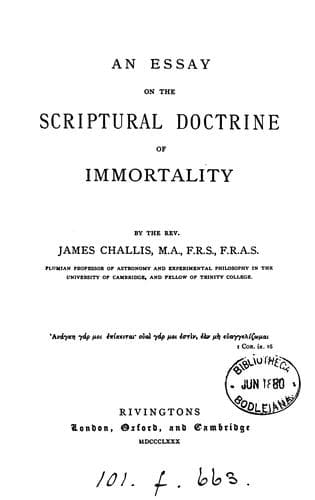
An Essay on the Scriptural Doctrine of Immortality — John Shaqi
An Essay on the Scriptural Doctrine of ImmortalityChallis, James
Religion
An Essay on the Scriptural Doctrine of Immortality
Challis, James
Immortality
which beset humanity, and it may be presumed that, with the intent of
accounting for their existence, they are put on record in the word of
God. On the broad principle that the Author of a world like this will
have vouchsafed reasons for its being such as it is, I accept the
Scriptures of the Old and New Testaments as the word of God written for
this very purpose, and instead of cavilling, as some do, at
difficulties which probably have no other foundation than their own
ignorance, it will be my {7} endeavour to make use of Scripture for
explaining the perplexities and difficulties which actually surround
the facts of human experience. The discussion of the particular
question I have taken in hand will give occasion for employing the
Scriptures in this manner, and in doing so I shall quote from all parts
indiscriminately, regarding the whole as sufficiently authoritative and
trustworthy for the purposes of the argument.
The above-mentioned general purpose the Scriptures may be supposed to
be adequate to fulfil, whether as expressed in the Hebrew tongue, or in
that of the Septuagint, or as translated in the English version,
notwithstanding that, as must be admitted, faults of transcription, or
translation, or interpretation have given rise to many verbal errors.
But the difficulties produced by these imperfections are of slight
importance in comparison with the great difficulty of discovering how
and on what principles to interpret the Scriptures so as to derive from
them the particular doctrines they are designed to teach. Amid the
great diversity of views that exists relative to modes of
interpretation, it may safely be maintained that the foremost and chief
requisite for making true deductions from the Scriptures is to have
_confidence_ in them as being depositions of Divine wisdom. Men of
science, in their endeavours to discover the secrets of Nature, are
baffled again and again, and yet by little and {8} little they obtain
accessions to knowledge just because they never doubt but that Nature,
if rightly interrogated, will give them true answers. It seems,
therefore, reasonable to expect that the words of God, handled on
principles analogous to those which have been successfully applied in
acquiring knowledge of His works, might be found capable of answering
the hard questions which are now, more, perhaps, than in past times,
agitating men's minds. This philosophy, having a surer basis than that
of any mere human intellectual system, might be expected to succeed
where these have failed. The bearing of these remarks on the main
subject of the essay will be seen as we go on.
Public-domain text, read in full here on John Shaqi.
Reviews
Reviews
No reviews yet
Be the first to share your thoughts on this work.
Join the Discussion
Join the discussion
Sign in to leave a comment or review.
Sign InorCreate an account