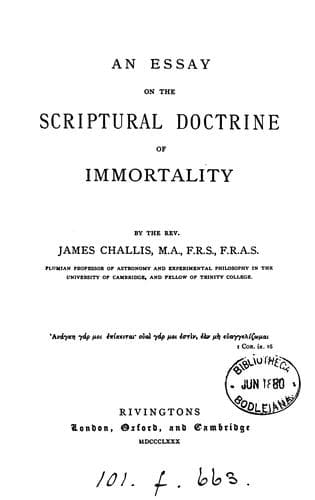
An Essay on the Scriptural Doctrine of ImmortalityChallis, James
Religion
An Essay on the Scriptural Doctrine of Immortality
Challis, James
Immortality
"I take this opportunity for expressing my approval of the arrangement
of the New Lectionary, by which chapters of the Book of Revelation are
now read more frequently than formerly before the people, this portion
of Scripture being indispensable for communicating to them the doctrine
of Jesus Christ in all its integrity.
"Cambridge, January 12,1878."
The difficulty experienced in the present day of rightly apprehending
the doctrine taught by our Lord in Matt. xxv. 46, and in like passages,
arises, according to the arguments contained in the Essay and in the
foregoing letters, from the little attention that is paid in the
Christian doctrine now generally accepted to what the Scriptures reveal
respecting "the age to come" (_aion ho mellon_) as distinguished from
"the present age" (_aion outos, aion ho paron_). The designation "age"
applied in common to both, indicates that each has a beginning and an
ending. The future age begins at the termination of the present age,
the separation between them being the epoch of a resurrection of the
dead--not, however, of all the dead, but "a resurrection of the just,"
that is, of those who have been prepared and sealed by faith, and
suffering, and good works, in the present life, for immediate entrance
into a new state of life. It is said of these that "they cannot {133}
die any more, and are the children of God, being the children of the
resurrection" (Luke xx. 36). These are they who "have part in the
first resurrection," of whom it is further said that "they _lived_ and
reigned with Christ a thousand years," whereas of "the rest of the
dead" it is said that "they _lived_ not till the thousand years were
finished" (see Rev. xx. 4, 6). It is plain, therefore, that there will
be a time of _separation_ of the one class from the other--the time of
_threshing_, when the tares are separated from the wheat; and that
whilst the elect at that time enter into the _[oe]onian_ life (that is,
the life of the age to come), the rest of the dead when they live again
enter into a state in which they undergo "[oe]onian punishment" (that
is, punishment that pertains to the age to come), ending eventually in
the second death, which, however, in common with all divine punishment,
is inflicted for producing a certain effect foreordained in the
counsels of the Almighty. (Respecting this effect, see what I have
said in the Essay and at the end of the first of the foregoing letters.)
Public-domain text, read in full here on John Shaqi.
Reviews
Reviews
No reviews yet
Be the first to share your thoughts on this work.
Elsewhere in the archive
Join the Discussion
Join the discussion
Sign in to leave a comment or review.
Sign InorCreate an account