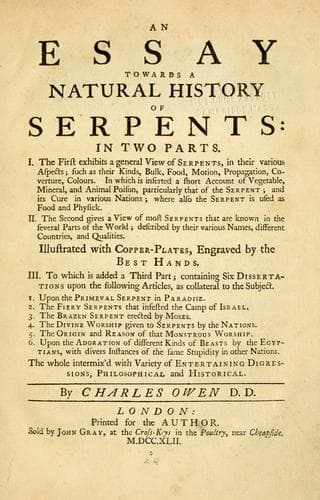
An essay towards a natural history of serpentsOwen, Charles
History
An essay towards a natural history of serpents
Owen, Charles
Serpent worship -- Early works to 1800; Serpents -- Early works to 1800; Serpents -- Religious aspects -- Early works to 1800
XCIV. The _Ground Rattle-Snake_, so called, only because it resembles
the real Rattle-Snake in Colour, but is somewhat darker: It never grows
above twelve or sixteen Inches long; ’tis reckon’d among the worst of
Snakes, and of a hardy Nature, because it keeps out of its
Winter-Quarters the longest of any. N. B. _This Serpent and some of the
following are taken out of the natural History of_ Carolina[263], a part
of _America_ belonging to _England_. The Natives of that Country were of
a larger Size than _Europeans_, and accounted so faithful in their
Promises, and so just in their Dealings, that they had no Words to
express _Dishonesty_, _Fraud_, or _Cheating_,—What contributed chiefly
to their honest Simplicity, and plain Method of living, was their
Contempt of Riches; were content with plain Food and Raiment, without
being anxiously sollicitous for to-morrow.
Footnote 263:
In the new _Collection of Voyages_, 4to, printed 1713.
XCV. The _Horn-Snake_, very venemous, hisses exactly like a Goose, upon
any body’s Approach. Serpents of this Class strike at the Enemy with
their Tail, which is arm’d at the end with a horny Substance, like a
Cock-Spur, that kills whatever is wounded with it. ’Tis said, that in
_Virginia_, they only shoot their Tongues, and shake them at the
Enemy[264].
Footnote 264:
_Lowthorp._ vol. iii, p. 599.
XCVI. The _Hydrus_, _Natrix_, or _Water-Snake_, of these are various
sorts, and all in some degree amphibious. When the _Coluber Aquaticus_
wounds any, ’tis attended with a most disagreeable Odour, and so strong,
that it forbids a near Approach to the unhappy Sufferer, who immediately
falls into a Tremor and Distraction, and soon expires (the third day,
says _Ælian_) without timely Relief[265].
Footnote 265:
_Ælian._ lib. iv. cap. 57. _Accessio Gyllii._—
Its common Residence is in shallow Waters, and when they are dried up,
it goes upon dry Ground, where its Wound is more dangerous than in
Water: But more of this elsewhere.
XCVII. In that Country they have what they call _Swamp-Snakes_; three
sorts of which are near a-kin to the Water-Snakes, and may be rank’d
among them. The Belly of the first is of the carnation Colour, the Back
is dark: the next, which is of a brown Colour, always abides in the
Marshes: the third is of a motley Colour, and very poisonous.
They dwell on the sides of Swamps, _i. e._ Bogs, Marshes, and Ponds,
have a prodigious large Mouth, and they arrive to the thickness of the
Calf of a Man’s Leg. Among these I place the black _Truncheon-Snakes_,
that live on the Banks of Rivers, which, when disturbed, shoot into the
Water, like an Arrow out of a Bow. I fancy the Name is borrow’d from a
certain Weapon call’d Truncheon, which we call _Battoon_, or Tipstaff,
of a cylindrical form, used by principal Officers of State, Generals,
and sometimes by Constables, when they go upon secret Expeditions.
Public-domain text, read in full here on John Shaqi.
Reviews
Reviews
No reviews yet
Be the first to share your thoughts on this work.
Elsewhere in the archive
Join the Discussion
Join the discussion
Sign in to leave a comment or review.
Sign InorCreate an account