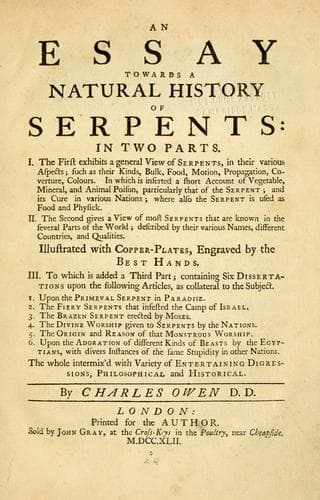
An essay towards a natural history of serpentsOwen, Charles
History
An essay towards a natural history of serpents
Owen, Charles
Serpent worship -- Early works to 1800; Serpents -- Early works to 1800; Serpents -- Religious aspects -- Early works to 1800
XCVIII. The _Red-belly-Snake_, this is so called from its ruddy Colour,
which inclines to an Orange-red. Of these are two sorts; one, like
_Abel_ the Innocent; the other, like _Cain_ the Cruel: An Emblem of the
World, humane, angelic Animal, and Vegetable, in which is a Mixture of
Good and Evil.
XCIX. The _Red-back-Snake_, so named from that Colour; a long, slender
Snake, but not very common. A certain Surveyor of Lands in _Carolina_
happen’d to step over one of these, which he did not see till his
Servant spy’d it: The Surveyor inquired of the _Indian_ that was along
with him, _Whether it was a very venemous Serpent?_ Who answer’d, _That
if he had been wounded by it, even the_ Indians _themselves, tho’ expert
in the Art of curing serpentine Wounds, could not have saved his
Life_[266].
Footnote 266:
_Natural History of Carolina._
Red, which is one of the primary Colours, proceeding from the least
refrangible Rays of Light, is a lively Emblem of Fire, or the fiery
Venom in this Serpent, whose principal Quality is to draw Blood.
C. The _Scorpion-Lizard_; ’tis commonly called so, but is no more like
it than a Hedge-Hog: It is indeed of the Lizard Colour, but much larger:
Its Back of a dark copper Colour; the Belly, in Orange; quick in its
Motion on the Ground, and very nimble in running up Trees; has several
Rows of Teeth, and is reckoned to be of a very poisonous Nature.
CI. The _Long Black-Snake_, is a land Animal, and very common. _I have_,
says my Author, _kill’d several of them, full six Foot in length_. Its
Bite, tho’ painful in its Consequences, is not deem’d commonly mortal:
the wounded Part swells, and turns to a running Ulcer. No living
Creature more nimble in Motion, or a greater Enemy to Mice, for it
leaves not one of that Vermin alive, wherever it comes. This Serpent
kills the Rattle-Snake, by twisting its Head about the Neck of that
Snake, and whipping her to death with its Tail.
This Serpent very much haunts Dairy-houses in those Countries, and makes
very free with unguarded Milk-Pans, and Cream-Pots: It delights to be
among Hens, whose Eggs it does not suck, but swallows them whole, as all
Snakes do their Sustenance. It will often swallow the Egg under a
sitting Hen, and then lie in the Nest in the form of a Ring.
Allow here a few Remarks upon the Nature of Milk and Eggs.
In all kinds of Vegetables is an oily Substance, which is a Fluid that
Animals take in with their Food, and no vegetable Food is nutrimental,
without some Proportion of this Oil; even Grass, especially in its Seed,
abounds therewith, which being thoroughly mixt with the _Saliva_, it
turns _milky_ in the Stomach: Which differs from the _Chyle_, only as
having been more concocted, and containing a large degree of Salt, which
renders it convertible into Curd.
Public-domain text, read in full here on John Shaqi.
Reviews
Reviews
No reviews yet
Be the first to share your thoughts on this work.
Elsewhere in the archive
Join the Discussion
Join the discussion
Sign in to leave a comment or review.
Sign InorCreate an account