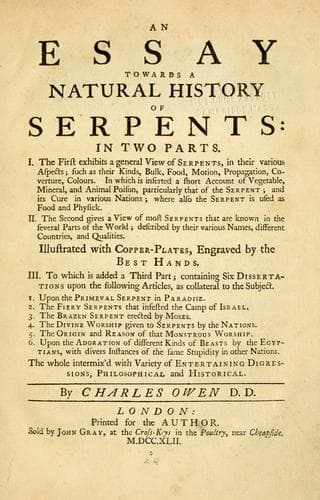
An essay towards a natural history of serpentsOwen, Charles
History
An essay towards a natural history of serpents
Owen, Charles
Serpent worship -- Early works to 1800; Serpents -- Early works to 1800; Serpents -- Religious aspects -- Early works to 1800
CXX. The _Tapayaxin_, a little wonderful Serpent; some say of the
Lacertan Kind, others say of an orbicular Form, not above four Inches
Long. The Body is cartilaginous, or gristly, smooth and solid. This kind
of Coverture is harder than a Ligament, and softer than a Bone, but is
not covered over with any Membrane to make it capable of Sensation.
It moves slowly, and recommends itself by Diversity of Colours: when
touched, the Body appears to be cold. Now, Bodies are said to be cold or
hot, as their Particles are in a greater or lesser Motion, than those of
the sensitory Organs. All Changes in the created Globe, are the Effects
of Motion, without which all Bodies would become unactive Masses[284].
Footnote 284:
_Newton_’s _Opticks_, p. 375.
This little Animal, is said to be pleased, or rather unconcerned, when
taken up by human Hands; called on that account, the _Friend of Man_;
that is, _he who is not against us, is for us_; therefore merits our
Smiles. His Situation corresponds with his natural Disposition, for it
is an Inhabitant of cold Regions. When its Head is comprest, Drops of
Blood gush out of his Eyes, which he casts to a great distance from him;
which agrees with a former Description, _&c._
CXXI. _DE Haro coloti genere._ The Serpent _Harus_, according to the
Historian[285], is a Native of the _Philippines_, and of the Lacertan
Tribe: a very long Head (like the _Philippine_ Queen) on a bulky Body,
terminating in a sharp Point. It resembles the _Quaquetzall_, is in
_Mexico_, and agrees therewith in most things, and of which it seems to
be a Species.
Footnote 285:
_Nierembergius_, cap. xxiv. p. 276. _Nascitur in Philippicis._
It chuses its Habitation among Shrubs adjacent to clear Streams, and
never defiles a Body, so prettily coloured, with muddy Water, till
constrained to make the Bulrush its Shelter against the excessive Heat
of the Sun[286].
Footnote 286:
_Ibid._ p. 276.
CXXII. The _Tamacolin_, or a Serpent called _Rubeta_, of the Lineage of
the red Toad: This kind is made up of Variety, differing only one from
another in Magnitude, Colour, and Poison. The lesser kind not so
venemous as the larger. Some are green, some are brown, and others
black. In showery Weather they make an open Appearance, and in such
Numbers, that none walk abroad without running the risk of a poisonous
Touch.
_NEW-SPAIN_ abounds with them, where they affect watry Habitations. In
_Peru_ are _Toads_ as large almost as _Cats_ or _Dogs_, but not so
poisonous as those of _Brazil_, where they have a Fish called _Amyacu_,
i. e. _Toad-Fish_; ’tis about a Span long, and oddly painted; its Eyes
are fine and fair: It swells and snorts when taken out of the Water,
which was the reason of giving it that Name: When flayed it may be
eaten, but is otherwise poisonous; the Poison is drawn out by
Application of Fire to the Part affected[287].
Footnote 287:
_Harris in Atlas for Brazil in General._
Public-domain text, read in full here on John Shaqi.
Reviews
Reviews
No reviews yet
Be the first to share your thoughts on this work.
Elsewhere in the archive
Join the Discussion
Join the discussion
Sign in to leave a comment or review.
Sign InorCreate an account