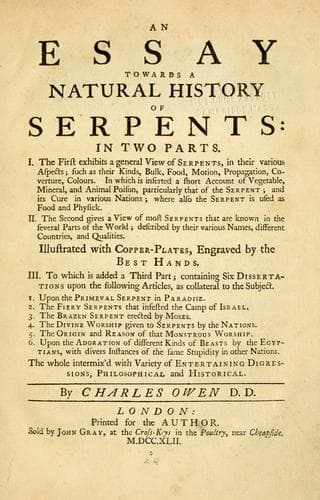
An essay towards a natural history of serpentsOwen, Charles
History
An essay towards a natural history of serpents
Owen, Charles
Serpent worship -- Early works to 1800; Serpents -- Early works to 1800; Serpents -- Religious aspects -- Early works to 1800
To this venemous Tribe, I shall annex a few Reptiles, in whose Veins I
find something of the Serpent’s Blood; and close the variegated List
with a large Account of the _Tarantula_, its Wound, and Cure by Musick;
then inquire into the Reasons of that strange Operation; the Nature and
Force of Sounds, not only on the Animal Passions, but Inanimate Matter.
I shall begin with,
I. The _Bee_, called the Honey-Fly, a little Animal that has four Feet,
which it carries close to the Belly, and not easily separated: It has
four Wings, small Teeth, and a long Tongue, which usually it carries out
of the Mouth. Its Sting cleaves to the Belly, which, when it strikes, it
parts with, and becomes uncapable of wounding a second time; which, I
think can’t be said of any other Member of the stinging Race, unless it
be the Wasp and Hornet.
The Sting, in the Design of it, seems to be only a Weapon of Defence; it
looks like a Tube or Pipe, hollow, with a little Bag of sharp
penetrating Liquid (which is its Poison) joined to the Extremity of it
within the Body, which, in stinging, is injected into the Wound thro’
the Tube; and tho’ venemous and painful, is not strong enough to corrupt
the Mass of Blood.
One may, with the naked Eye, sometimes see this little Insect discharge
its Venom, in which, says the ingenious Dr. _Mead_, by the help of a
Glass, I can easily discover _a great Number of minute Salts floating_.
In _Brazil_, _Bees_ are distinguish’d into twelve kinds, among which are
some that sting in a most furious and fatal manner, called _Mateecas_ by
the _Indians_.
In _Ceylon_ in the _East-Indies_, are several Bees, the largest are of a
brighter Colour than ours; they make their Combs on the Boughs of Trees:
At proper Seasons, the Inhabitants hold Torches under them, till they
drop down, which they carefully gather, boil and eat, and are accounted
excellent Food. In _Quatemala_ are Bees and Honey of a white Colour, and
some without a Sting, says the Historian[308].
Footnote 308:
_Nierembergius_, p. 286.
II. To the _Bee_, I add the _Wasp_, which, as it is something larger,
makes a deeper Wound; it differs also from it in its Food, which is
Flesh and Carrion, when it can be got; whereas the Bee regales itself
with delicious Entertainments, and enriches its Family with all the
Glories of the vegetable Kingdom. From whence is the Honey? I answer,
That in Flowers is found a viscid sweet Juice, and accordingly we see
Children gather Cowslips, Honeysuckles, and suck the Honey from them.
The Bees visit all Flowers within their Reach, and putting it in their
Trunks, suck out the Honey, with which they load their Stomachs, to be
discharg’d, and laid up in their Combs. Among the Antients, Honey was
taken for a Dew that fell on Flowers; but this is a mistake, because the
Bees only gather it after the Sun is up, when there is no Dew left, or
very little.
Public-domain text, read in full here on John Shaqi.
Reviews
Reviews
No reviews yet
Be the first to share your thoughts on this work.
Elsewhere in the archive
Join the Discussion
Join the discussion
Sign in to leave a comment or review.
Sign InorCreate an account