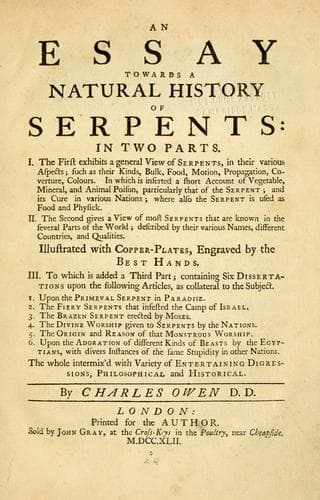
An essay towards a natural history of serpentsOwen, Charles
History
An essay towards a natural history of serpents
Owen, Charles
Serpent worship -- Early works to 1800; Serpents -- Early works to 1800; Serpents -- Religious aspects -- Early works to 1800
III. The _Hornet_ is yet more dangerous, and has been known to pursue a
Sparrow, and kill it, and then suck its Blood. The Hornet and Wasp have
strong Jaws tooth’d, by which they can dig into Fruits, for Sustenance;
yea, and into harder Substances, for Quarters.
If you take a Bee, a Wasp, or Hornet, and gently squeeze the Tail, so
that you can see the Sting, you may perceive a Drop of transparent
Liquor at the very end of it; which if wiped off, you shall soon see it
renew’d, that Liquid passing down the Cavity into the end thereof: ’Tis
said the Decoction of Hornets dropt on the Skin, makes it swell.
IV. I proceed to the _Spider_, another little venemous Insect, whose
forked Tongue or Sting, is very fine and sharp; by this he pierces
Flies—and at the same time, instils a poisonous Juice into the Wound, by
which the Prey being kill’d, it sucks out the Moisture, and leaves
nothing but a husky dry Carcass: Tradition says, it poisons by spitting,
or breathing, because it dare not approach so near to a large Fly as to
a little one; but keeps at some distance, and uses a kind of shoving
Motion, upon which the Fly has done struggling.
There are various sorts of these little strange Creatures, whose Stings
are hurtful, as the _Astorius_, (so called from its resemblance to a
Star) whose Wound produces Heaviness, and Relaxation of the Nerves. The
_Cæruleus_, or blue Spider, whose Sting is attended with Vomiting and
Pain at the Heart. The _Lycos_, the least of the kind, that causes an
_Asthma_, and Swelling about the wounded Part. In the _Philosophical
Transactions_, we have a Table of thirty-three kinds of Spiders found in
_England_, by Dr. _Lister_[309].
Footnote 309:
_Lowthorp_, vol. ii. p. 793.
There is something very curious and admirable in those long Threads they
make in the Air, during some part of Summer, especially towards
_September_, so much wonder’d at, in such Quantities every where. The
Method of Operation, I take to be as follows, _viz._
All Spiders that spin in a Thread, are the Makers of those Threads, most
visible in the Autumn. In all the ways of weaving, they still let down
the Thread they make use of, and draw it after them. Attending on one
that wrought a Net, I saw it, says a very nice Observer, suddenly in the
Mid-work desist, and turning his Tail into the Wind, to dart out a
Thread, with the Violence we see Water spout out of a Spring: This
Thread taken up by the Wind, was in a Moment emitted some Fathoms long,
still issuing out of his Belly; by and by the Spider leapt into the Air,
and the Thread mounted her up swiftly.—And I found the Air fill’d with
young and old, sailing on their Threads, and undoubtedly, says the
Relator, seizing Gnats and other Insects in their Passage; there being
often manifest Signs of Slaughter, as Legs, and Wings of Flies ... on
these Lines, as in their Webs below[310].
Footnote 310:
_Lowthorp_, vol. ii. p. 794.
Public-domain text, read in full here on John Shaqi.
Reviews
Reviews
No reviews yet
Be the first to share your thoughts on this work.
Elsewhere in the archive
Join the Discussion
Join the discussion
Sign in to leave a comment or review.
Sign InorCreate an account