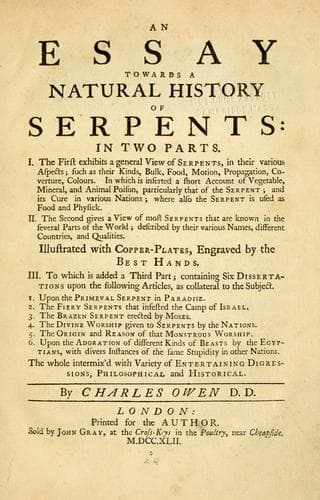
An essay towards a natural history of serpentsOwen, Charles
History
An essay towards a natural history of serpents
Owen, Charles
Serpent worship -- Early works to 1800; Serpents -- Early works to 1800; Serpents -- Religious aspects -- Early works to 1800
It follows hence, that _Self-denial was a Duty in Paradise_. _Adam_ was
not an absolute Sovereign to do what he pleased, but what his Almighty
Creator and Patron prescribed; tho’ endowed with Reason, yet was he to
govern himself by the Will of another, that is, of him who was the
Donor. His Reason was a bright, but borrowed Light, borrowed from the
uncreated Sun, therefore ought to move by its Direction.
Thus we see that Restraints on the human Nature, were necessary even in
Man’s Paradisaical State: To deny Self, was one of the Precepts of
Religion in the Garden of Innocence; nor is this strange, if we
consider, that for any rational Creature to live according to his own
Will, is to make a _God_ of his _Will_.
Why did God forbid the Fruit of one Tree? This might be to signify
_Adam_’s Dependance upon his Maker, and that he had no Claim to any
thing without his Leave: The sovereign Lord of the Creation made over to
_Adam_ large Dominions, and the Mannour of Paradise for the Seat of his
Empire, reserving nothing to himself but a small Rent of Acknowledgment,
which was only the Fruit of one Tree. The Exemption of this Tree from
human Use, notify’d Man’s Subjection, and God’s supreme Dominion. By
this Reservation he tried their Obedience, whether they would be content
with all the Earth, and Appurtenances thereunto belonging, one Tree only
excepted. _N. B._ This forbidden Tree might have something of a natural
Tendency to corrupt the animal Juices, and introduce Diseases and Death
into the human Nature. If the Tree of Life could immortalize our
Existence in Happiness, is it not equally rational to suppose the Tree
of Knowledge ... would destroy it?
III. _THE Laws of Paradise were inforced by a very awful Sanction_, viz.
_Life and Death_: The one expressing something most terrible, the other
implying somewhat vastly delightful. Threatnings were necessary Cautions
in Paradise: How surprizing this! The first day of Man’s Life, Man was
put in mind of Death, of which the Tree of Life was a Memento. If you
eat the Fruit of it, you forfeit your Life, _die you must_ without
Remedy. This Menace of Death, in the Design of it, was to guard against
Sin, as that which only could be the Cause of Death.
_IN the day thou eatest thereof_, dying thou shalt die; or, die the
Death. Behold here! as in a Cloud, the first Alarm of Mortality, the
first Institution of Funerals, and the melancholy Office of
Grave-diggers. Bells from the Pinnacle of the Temple, proclaim it aloud
to Man, _Dust thou art, and unto Dust thou shalt return_. In this
paradisaical Scheme of Government, we find Death to be a near Neighbour
to Life: Both the Trees grew near to one another.
Public-domain text, read in full here on John Shaqi.
Reviews
Reviews
No reviews yet
Be the first to share your thoughts on this work.
Elsewhere in the archive
Join the Discussion
Join the discussion
Sign in to leave a comment or review.
Sign InorCreate an account