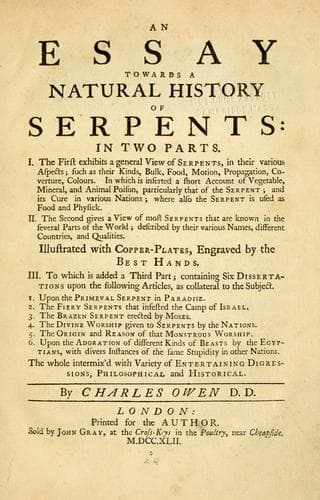
An essay towards a natural history of serpents — John Shaqi
An essay towards a natural history of serpentsOwen, Charles
History
An essay towards a natural history of serpents
Owen, Charles
Serpent worship -- Early works to 1800; Serpents -- Early works to 1800; Serpents -- Religious aspects -- Early works to 1800
Some Serpents are _carnivorous_, and feed on Flesh; others are
_verminivorous_, and feed on Reptiles: Their Sustenance is various,
suited to their several Constitutions, and Nature of the Climates, where
they inhabit. Vipers and Adders feed on Herbs, Weeds, Dews, as well as
upon Lizards, Mice, Frogs.—When they take Food into their Mouths, they
raise up their Bodies a little, that they may swallow their Prey with
less difficulty. They swallow those little Animals whole without
chewing. In a Viper dissected by a certain Gentleman, he found three
large Mice, intire, without any Change of their Form by hard
Compressure. _Scorpions_ live chiefly upon Locusts, and other winged
Insects. In _Arabia_, ’tis said, they feed upon _Balsam-Juices_, and
seem to delight much in the Shadow of that Tree[17].
Footnote 17:
_Conrad, Gesner._ 85.
It is remarkable, that Nature has provided young Vipers with poisonous
Teeth grown to Perfection, commensurate to their Bulk, that so they may
immediately feed themselves, by being able, in some measure, to kill
their Prey as soon as they are born. Some of these Animals have
temporary Parts, as the _Lacerta Aquatica_, a little Water-Serpent,
which, when young, has four ramified Fins, to poise and keep its Body
upright, (which gives it the Resemblance of a young Fish) and these fall
off when the Legs are grown: So Frogs and Toads, in their _Tadpole
State_, have Tails, which fall off when their Legs are grown out[18].
These pass through various Transmigrations, before they arrive at their
perfect State.
Footnote 18:
_Derham’s Phys. Theol._ B. IV.
----------------------------------------------------------------
SECTION V.
As Serpents differ in Kind, so in Size; the Length to which some of them
grow is most surprizing. A certain Number is sent out with little
Bodies; others are of monstrous Bulk, and capable of making the
strongest Efforts against all the Attempts made to destroy them; yea,
are strong enough to contend with _Elephants_, the greatest of Animals,
and conquer them. _e. gr._
_ATTILIUS REGULUS_, the _Roman_ General in _Africa_, is said to
encounter a Serpent in that Country, of vast Strength and Stature, near
the River _Bagrada_, 120 Feet long, which he and his Army could not
subdue, without discharging all their Engines of War against it; and,
when conquered and flea’d, its Skin was conveyed to _Rome_ in
Triumph[19]. This is the more credible, says _Pliny_, because, in
_Italy_, we see other Serpents, called _Boæ_, so large that in the Reign
of _Claudius_, there was one of them killed in the _Vatican_, within
whose Belly was found an Infant whole[20].
Footnote 19:
_Prœlium grands & acre eumque magna totius exercitus conflictatione,
balistis atque catapultis diu oppugnatum—Ejusque interfecti longum
corium pedes 120. Aul. Gellii Noct. Att._ _Liber_ VI. _Cap._ iii.
Footnote 20:
_Nat. Hist._ B. VIII. _Cap._ xiv.
Public-domain text, read in full here on John Shaqi.
Reviews
Reviews
No reviews yet
Be the first to share your thoughts on this work.
Join the Discussion
Join the discussion
Sign in to leave a comment or review.
Sign InorCreate an account