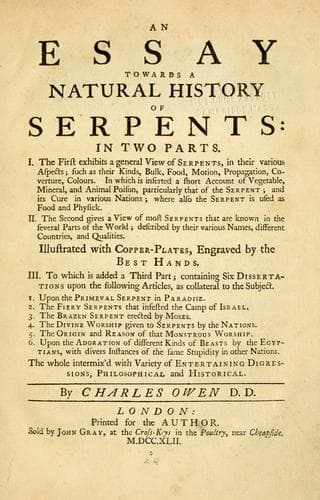
An essay towards a natural history of serpentsOwen, Charles
History
An essay towards a natural history of serpents
Owen, Charles
Serpent worship -- Early works to 1800; Serpents -- Early works to 1800; Serpents -- Religious aspects -- Early works to 1800
VIII. I now proceed to the Serpent _Scytale_; the Name is borrowed from
the _Greek_ Word σκυταλη, a Staff, or any thing like a Cylinder, of a
long smooth round Form; the Body of this Serpent being in shape equally
round, like a Rolling-Stone, with very little Variation in the
Extremities of it.
[Illustration:
_Plate 2^d._
]
It forms a beautiful Prospect, being an Aggregate of most charming
Colours, (therefore call’d the Painted Serpent by _Mantuanus_.) It may
be view’d without danger, because slow in its Motion. ’Tis an Error in
_Lucan_ to attribute its Slowness to a Design of enticing Spectators, if
it be not _Poetica Licentia_.
When released from its Winter-Confinement, the first thing she does,
says the Historian, is to refresh her languid Body with Fennel-Leaves;
but does not tell us what is done, in case that Herb can’t be readily
found. It must indeed be allowed, that wild Fennel is a common Herb of
the Field, and well known and of Use in Physick[138]. The Poet observes,
that no Snake casts her Coat in Winter, but the _Scytale_[139].
Footnote 138:
_Ælian_, _Gyllii Accessio_.
Footnote 139:
_Et Scytale sparsis etiam nunc sola pruinis Exuvias positura
suas._—Lucan’s Phars.
This Serpent being adorned with beautiful Colours, excuse a short
Digression upon the Doctrine of Colours in Natural Bodies. Know then,
Colours are the Children of Fire and Light.
I. _Where there is Light, there is Fire_; and Fire shews itself to be
present by Light. The Sensation of Light is produced when the Particles
of Fire, directed by the Action of the Sun, reach the Eye in right
Lines. Now, Fire thus entering the Eye, gives a Motion to the optic
Fibres at the bottom of the Eye, and thus excites the Idea of Light.
II. _FIRE discovers itself by Colour_; for all Colours depend upon
Light, and Light depends upon Fire; and different Colours appear in
Natural Bodies, as their Surfaces are disposed to reflect this or that
sort of coloured Rays more than others. Colour is a Property inherent in
Light.
Colours therefore are not connate with Natural Bodies, which are all of
the same Hue in the dark. To this the Poet alludes, when he makes
_Darkness the Destruction of Colours_[140].—Colours are only in the Rays
of the Sun: In Natural Bodies is a Quality or Power to reflect the Light
falling upon them, which striking the Eye, produces in the Spectator the
Sensation of Colour.
Footnote 140:
_Rebus nox abstulit atra colores._—Virgil.
Clouds often appear very beautifully coloured; they consist of aqueous
Particles, between which Air is interspersed; therefore, according to
the various Thickness of those aqueous Particles, the Cloud will be of a
different Colour[141].
Footnote 141:
_Boerhaave_, _Gravesand_.
Public-domain text, read in full here on John Shaqi.
Reviews
Reviews
No reviews yet
Be the first to share your thoughts on this work.
Elsewhere in the archive
Join the Discussion
Join the discussion
Sign in to leave a comment or review.
Sign InorCreate an account