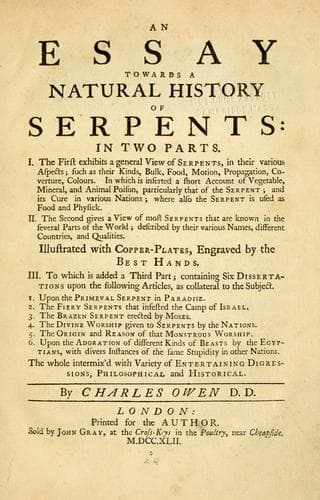
An essay towards a natural history of serpentsOwen, Charles
History
An essay towards a natural history of serpents
Owen, Charles
Serpent worship -- Early works to 1800; Serpents -- Early works to 1800; Serpents -- Religious aspects -- Early works to 1800
IX. _AMPHISBÆNA_ Serpent, so called from αμφι _&_ βαινω _Biceps_, a
Monster with two Heads. This is a small and weak Creature, equal in Bulk
to a little Finger, and about a Foot long, of a whitish or terraceous
Colour; of the oviparous Family, of small Eyes, no otherways visible
than the Prick of a little Needle; lives much under ground, and is often
found by digging; feeds upon Ants. Under this Head, the Historian
mentions three Serpents, _viz._
The _Brasilian_, that has two Heads, and moves as a Crab[142].
Footnote 142:
_Acosta._
The _Taprobanensian_, with four Heads; and he who believes it must have
a four-headed Faith.
The _Hungarian_; of which elsewhere.
The same Historian adds, that the marine _Amphisbæna_, taken in the
_English_ Sea, has two Heads. _Ibid._ _Pliny_, _Ælian_, _Lucan_,
_Mantuan_,—affirm it has two Heads; _Matthiolus_ denies it, _Hesychius_
is doubtful. Mention is made of a Serpent found near _Chipping-Norton_,
not far from _Oxford_, having two Heads, and Faces like Women; one being
shaped after the new Tyre of that Time; the other was habited after the
old Fashion, and had great Wings resembling those of the Flinder-Mouse
or Bat[143]. This happened in the Reign of _Edward_ III.
Footnote 143:
_Stow_’s Annals, _London_, printed, 1631.
A _Spanish_ Author says, that in _Chiapa_ he found a two-headed Serpent,
18 Inches long, in the Form of a _Roman_ T, and very venemous; it does
not only kill, adds he, by its Bite, but if any tread upon that part of
the Ground over which ’twas just gone, it proves fatal[144]. The Poet
also subscribes to two Heads[145].——If this two-headed Serpent has slain
its Thousands, there is a certain metaphorical three-headed Serpent on
the Banks of _Tyber_, that has slain its Ten Thousands.
Footnote 144:
_Antonio de Herrera_’s History of _America_.
Footnote 145:
_Et gravis ingenium surgens caput Amphisbæna._—Lucan, p. 270.
Perhaps the Reason of ascribing two Heads to this Serpent, might be,
because it is said to poison by the Tail and Teeth. Others say, both
Ends are so like in Figure and Bulk, that they are not easily
distinguished.
It seems probable to me, that this Serpent, like some Insects or Worms,
has a double Motion, _antrorsum & retrorsum_, which made some of the
Antients conclude it had two Heads; one in the usual Situation, the
other in the Extremity of the _Cauda_. Its Body is of equal Thickness,
and recommended to the View by various and delightful Spots[146].
Footnote 146:
_Conrad. Gesner._ _Ælian._ _Columella_, lib. vi.
We read of this Serpent in _Gothland_, where it comes forth in the
Spring before all other Serpents, being more able to encounter the cold
Air[147]. Some Authors tell us, that its Skin wrapt about a Stick,
drives away all Serpents; which I place among the Tales of Antiquity.
Footnote 147:
_Olaus Magnus Hist._ B. xxi.
Public-domain text, read in full here on John Shaqi.
Reviews
Reviews
No reviews yet
Be the first to share your thoughts on this work.
Elsewhere in the archive
Join the Discussion
Join the discussion
Sign in to leave a comment or review.
Sign InorCreate an account