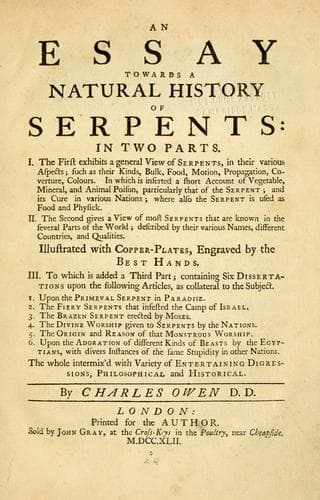
An essay towards a natural history of serpentsOwen, Charles
History
An essay towards a natural history of serpents
Owen, Charles
Serpent worship -- Early works to 1800; Serpents -- Early works to 1800; Serpents -- Religious aspects -- Early works to 1800
This Serpent resembles the Ash in Colour, inclining to the white. It
traverses the _Lybian_ Provinces, where it makes travelling dangerous:
It is also found in the Island of _Rhodes_; an Island on which, the
Poets tell us, _Golden Showers are rain’d_, and where the Air is never
so clouded, as to hinder the Light of the Sun. It appears also in
_Norway_, according to _Olaus Magnus_.
One tells us, that he was inform’d by one _John Vitus_, a learned
_Hungarian_, that there were in that Country _little Serpents_ about six
Inches long, and without a Tail, therefore called by the Vulgar, the
_curtail’d Serpent_, the whole Body is much of an equal Thickness; and
these, upon View of their Prey, leap upon it with the Swiftness of an
Arrow[172].
Footnote 172:
_Conrad. Gesner. in Verbum._
XVI. The _Druina Serpent_ from δρυς, an Oak, by _Scaliger_ called
_Querculus_; it takes its Name from the Oak, in whose hollow places it
seems to reside; and to which, it retires for Refuge, when assaulted by
Hornets.——Some credulous Authors have said, that these Serpents take up
their hybernal Lodgings about the Roots of the _Beach-trees_, and by
Virtue of the Warmth, which those Roots derive from them, that Tree, so
enhappy’d, flourishes all Winter.
This Serpent is of the amphibious kind, and a most venemous Creature,
therefore rang’d with the first Order of the serpentine Race. ’Tis of
monstrous bulk[173], guarded by a rough squammatick Armour, in the
Cavities of which, ’tis said, little Flies build their Nests. Whether it
appears in white or blue Habit, is not material, nor do I see what
Honour it gets by wearing a Coronet on its Head.
Footnote 173:
It is a Load for a Porter.
In the Language of Tradition, to tread upon it, will cause an
Excoriation in the Foot, (tho’ no Wound be given) and a Tumor in the
Leg; yea, adds the Traditionist, the Hands that attend the Patient, will
be in danger of losing their Skin: But he who believes all the Fables of
Antiquity, is in more danger of losing his Reason.
The Druinical Serpent goes under various Denominations. ’Tis said to
follow the _Acontia_ in Authors, because its Figure exactly quadrates
with _Bellonius_’s dart Serpent; and _Scaliger_ was in the same
Sentiment[174].
Footnote 174:
_Jonstonus_, Articul. xiii. p. 21.
But I shall only mention that of _Chersydrus_, from _Nicander_ in
_Jonstonus_, p. 28. or _Chelydrus_, called by some a _Sea-Snail_; which
the learned Sir _Hans Sloane_ describes thus——
“That it is more flat than most of the cochlean Marines,
consisting only of Circumvolutions, round the Axis of the Shell;
of a fine purple Colour.”
He calls it _Cochlea Marina_[175], and not without reason, because of
their difference in Magnitude.
Footnote 175:
His Voyage to _Jamaica_, vol. i. p. 34.
Public-domain text, read in full here on John Shaqi.
Reviews
Reviews
No reviews yet
Be the first to share your thoughts on this work.
Elsewhere in the archive
Join the Discussion
Join the discussion
Sign in to leave a comment or review.
Sign InorCreate an account