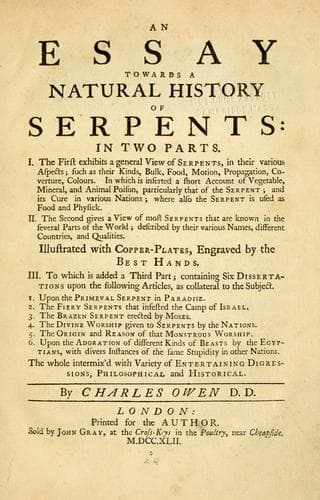
An essay towards a natural history of serpentsOwen, Charles
History
An essay towards a natural history of serpents
Owen, Charles
Serpent worship -- Early works to 1800; Serpents -- Early works to 1800; Serpents -- Religious aspects -- Early works to 1800
The terrestrial _Druina_ lives upon Frogs, and other Insects; many of
them are found in _Africa-Interior_, and the _Hellespont_ by
_Constantinople_. It is a fetid Animal, and sends forth an ill Scent,
especially when its Body is wounded[176].
Footnote 176:
_Ælian._ _Gyllius._ _Gesner._
This Serpent exceeds most in bulk, and loudness in hissing, which
resembles the Cry of _Sheep_ and _Goats_, ibid. _Gyllius_ makes the
_Druina_ to be the _Chelydrus_, described by the Poet, who makes it a
_Calabrian_[177]: Of which, more in another place.
Footnote 177:
——_Nidore chelydros
Est etiam ille malus colubris in saltibus anguis
Postquam exhausta palus._—Virg. Georg. l. iii. This is applied also
to the _Hydrus_.
XVII. The _Elops_ or _Elaphis_ of the Antients, which some confound with
the _Cæcilia_, as _Jonstonus_ observes: It is of the amphibious Sort,
and known at _Lemnos_, where ’tis call’d _Laphiati_ by the Natives. In
_Aldrovandus_’s Study, _Ambrosinus_ saw the Picture of this Serpent,
which was about three Foot long; the Belly is of a yellow Colour, the
Back is brown, and distinguishable by three black Lines[178].
Footnote 178:
_Ray._
There is a _marine Elope_, an Animal counted sacred by the Poets, a Set
of merry Mortals, famous for turning every thing into a _God_, or
_Ridicule_. The Historian mentions a certain Fish so called, that upon
any loud Noise made on Land near the Shore, would immediately hasten
towards the Place, as if it would see who durst rival _Triton_ in Sound;
_Triton_, Herald of _Neptune_, Sovereign of the Sea.
XVIII. The _Pareas_ or _Parvas_, is a Serpent of a fiery Colour, sharp
Eyes, wide Mouth, two Feet situated near the Tail, by which its Motion
is guided[179]: It is called the Serpent of _Esculapius_, being of a
gentle, innocent, friendly Nature. In _Italy_ they frequent Houses, and
are no more dangerous than common Eels; and if provoked to exercise
their Teeth, there is nothing venemous in the Bite. This is supposed by
some to be the _Italian Baron_: One of its commendable Properties is,
that it devours poisonous Serpents; and therefore is sacred to the
Mysteries, and highly esteem’d in the Temple of _Dionysius_.
Footnote 179:
_Et contentus, iter cauda sulcare Pareas._ Lucan. Phars. 270.
_Gesner_[180], from _Albertus_ says, it goes as it were upright, on its
Tail, not perpendicularly upon the sharp End, but on that Part of the
Body joined to the Tail: It is bred in _Syria_, _Alexandria_, and in the
East, _&c._ These Serpents are known also in _Spain_ and other temperate
Regions, and every where esteemed Enemies to hurtful Serpents, and
Friends to Mankind; therefore were consecrated to the divine
_Esculapius_, that great and glorious Exemplar of Humanity.
Footnote 180:
_Quasi totus erectus graditur super caudam._ l. v. p. 65.
Public-domain text, read in full here on John Shaqi.
Reviews
Reviews
No reviews yet
Be the first to share your thoughts on this work.
Elsewhere in the archive
Join the Discussion
Join the discussion
Sign in to leave a comment or review.
Sign InorCreate an account