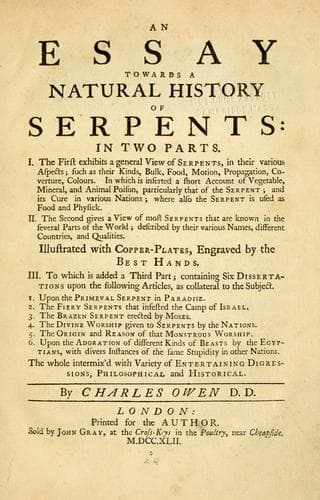
An essay towards a natural history of serpentsOwen, Charles
History
An essay towards a natural history of serpents
Owen, Charles
Serpent worship -- Early works to 1800; Serpents -- Early works to 1800; Serpents -- Religious aspects -- Early works to 1800
The _Cameleon_ is an oviparous Animal. _J. Jonstonus_ says, it has above
a hundred Eggs, from _Piereskius_, who nursed a Female on purpose to
make Observations upon the Subject[213]. After all the Gentleman’s Care
about ’em at _Smyrna_, all of them died within five Months; and having
opened the Female, found thirty Eggs in her, fasten’d one to another in
the form of a Chain. _Ibid. supra._
Footnote 213:
_Jonstonus de Animalib. inter Quadrupedes_, p. 141.
The _Atlas_[214] calls the _Cameleon_, the _Indian Salamander_[215];
that goes there by the Name of _Gekho_, from the Noise it makes after
hissing, and is thus describ’d, _viz._ ’tis about a Foot long and
spotted, has large Eyes starting out, the Tail has several white Rings
round it, and its Teeth sharp, and strong enough to penetrate an Armour
of Steel: it has a slow Motion, but where it fastens, ’tis not easily
disengaged. This Creature is found in _Arabia_, _Egypt_, _Madagascar_,
_Java_, and other parts of _India_. _Bellonius_ saw several of them
among the Shrubs of _Attica_[216]: He says it frequents _Cairo_, and
other Places, is found among Hedges and Bushes; mutes like a Hawk;
swallows every thing whole. It moves the Feet of each side alternately,
but runs up Trees very fast, and lays hold on the Boughs with its Tail.
_Leo_ and _Sandys_ say, the Neck is inflexible, and it can’t turn
without moving its whole Body: the Back is crooked, the Skin is spotted
with little Tumours: the Tail long and slender, like that of a Rat, when
it sucks in the Air, its Belly swells, whence some think that the Air is
part of its Food. One Author says, it subsists only upon Air; another
says, ’tis a vulgar Error.——
Footnote 214:
_Africa._
Footnote 215:
For _America_.
Footnote 216:
_Jonstonus de Quadrupedibus._
’Tis said, that if a Serpent lurks near the Tree, where it sits, it
throws a Thread out of its Mouth, with a little shining Drop at the end,
which falls upon the Serpent’s Head, and kills it[217].
Footnote 217:
_Atl. Afric._ p. 49, 50.
In _America_ are Serpents, some of whom are so poisonous, that if
touch’d but with a little Stick, the Venom runs up the Hand; and such as
are touch’d with the Blood of dead Serpents, die a lingering Death: This
is Tradition: I shall begin with the first of them, _viz._
XXX. _KUKURUKI_, a Serpent of _Brasil_ in _South-America_, which is
under the torrid Zone, where their Winter begins in _March_ and ends in
_August_; and is like our Summer. This Serpent is of an ash Colour, and
in its Scales resembles the _Bocinga_, or Rattle-Snake, but is more
gross; on the Back, variegated with yellow, and large black Spots. ’Tis
represented as a very venemous Animal, eight or nine Foot long[218]; and
when prepared, the Inhabitants feed upon it.
Footnote 218:
_9 & interdum 12 pedes longus est._ Ray.
Public-domain text, read in full here on John Shaqi.
Reviews
Reviews
No reviews yet
Be the first to share your thoughts on this work.
Elsewhere in the archive
Join the Discussion
Join the discussion
Sign in to leave a comment or review.
Sign InorCreate an account