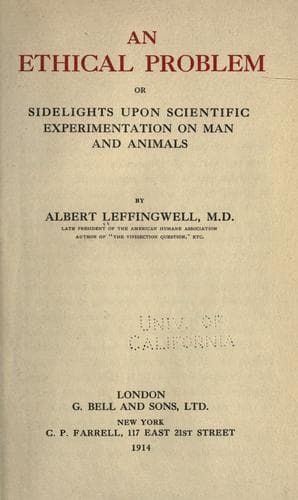
An ethical problem; or, Sidelights upon scientific experimentation on man and animalsLeffingwell, Albert
Philosophy
An ethical problem; or, Sidelights upon scientific experimentation on man and animals
Leffingwell, Albert
Medicine, Experimental; Vivisection
"In conjunction with Mr. Bury, I have made some investigations
concerning the action of salicine on the human body, USING HEALTHY
CHILDREN FOR OUR EXPERIMENTS, to whom we gave doses sufficient to
produce toxic (poisonous) symptoms. We tested the effects of salicine
in three sets of experiments ON THREE HEALTHY LADS. To the first two,
we gave large doses, and produced decided symptoms.... Under toxic
(poisonous) but not dangerous doses, the headache is often very
severe, so that the patient buries his head in the pillow. There may
be very marked muscular weakness and tremour...."
Another "set of experiments" was made on a boy ten years old, who had
been brought to the hospital to be treated for belladonna poisoning.
"Our observations," said Dr. Rigner, "were not commnced TILL SOME DAYS
AFER HIS COMPLETE RECOVERY." Among effects of the experiment was a
severe headache,--"so severe that the lad shut his eyes and buried his
head in his arm...became dull and stupid, lying with his eyes
closed...."
Other experiments were made upon a boy only nine years old, almost
well from an attack of pneumonia, the temperature having become normal
over a week before. Dr. Ringer's experiment went so far as to give
him apparently considerable apprehension. He speaks of the flushed
face, the trembling hand, and lips, the laboured breathing, the
spasmodic movements of limbs.
"These symptoms were at their height at midday, and were so marked,
and the pulse and respirations so quick, that we must confess we felt
a little relief when the toxic (poisonous) symptoms which became FAR
MORE MARKED THAN WE EXPECTED, abated; not that at any time the boy was
dangerously ill; but as the symptoms progressed, after discontinuing
the medicine, WE DID NOT KNOW HOW LONG AND TO WHAT DEGREE THEY MIGHT
INCREASE." (!)
What shall be said of experiments like these, made upon children who
had almost or quite recovered from ailments for which medical advice
was sought?
Poisoning with Ethyl-Atropium.
This drug has no recognized medical use. In order to make experiments
with it upon patients under his care, Dr. Ringer was obliged to have
it specially manufactured. He refers to "our experiments upon man,"
and states that the poisonous substance
"produces decided but transient paralysis, THE PATIENT BEING UNABLE TO
STAND OR WALK, and the head dropping rather toward the shoulder or
chest, and the upper eyelids drooping."[1]
[1] Ringer's "Therapeutics," p. 534.
Experiments with Tartar-Emetic, or Antimony.
Of this poison, an American authority tells us that "the fraction of a
grain" may be followed by a fatal result. Dr. Ringer states,
nevertheless, that,
"TO A STRONG YOUNG MAN, I gave tartar-emetic in the 1/2-grain doses
every ten minutes for nearly seven hours, INDUCING GREAT NAUSEA AND
VOMITING with profuse perspiration."[2]
[2] Ibid., p. 273
Public-domain text, read in full here on John Shaqi.
Reviews
Reviews
No reviews yet
Be the first to share your thoughts on this work.
Elsewhere in the archive
Join the Discussion
Join the discussion
Sign in to leave a comment or review.
Sign InorCreate an account