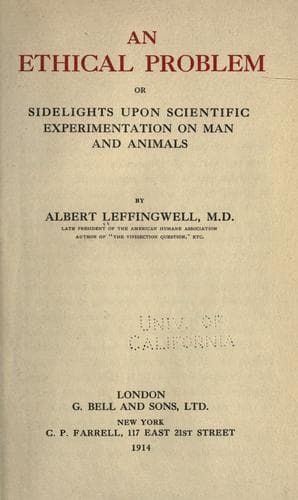
An ethical problem; or, Sidelights upon scientific experimentation on man and animalsLeffingwell, Albert
Philosophy
An ethical problem; or, Sidelights upon scientific experimentation on man and animals
Leffingwell, Albert
Medicine, Experimental; Vivisection
Twenty-one grains of antimony administered to "a strong young man,"
though a fatal result may be inducted by a fraction of a single grain!
Poisoning with Alcohol.
With this substance, Dr. Ringer tells us he made a great many
observations "every quarter of an hour for several hours ON PERSONS OF
ALL AGES.... After poisonous doses, the depression (of temperature) in
one instance reached nearly three degrees."
Does this sinister confession mean that even infants were the objects
of his scientific zeal? It is certain that some children were
subjected to this experiment, for he says:
"In a boy aged ten, who had never in his life before taken alcohol in
any form, I found through A LARGE NUMBER OF OBSERVATIONS, a constant
and decided reduction of temperature."
Is there any parent who would be willing to have his ten-year-old boy
subjected to an experiment like this?
Poisoning with Nitrate of Sodium.
"To eighteen adults, fourteen men and four women, we ordered 10 grains
of pure nitrate of sodium in an ounce of water, and of these,
seventeen declared they were unable to take it.... One man, a burly
strong fellow, suffering from a little rheumatism only, said that
after taking the first dose, he felt giddy as if he `would go off
insensible.' His lips, face, and hands turned blue, and he had to lie
down an hour and a half before he dared moved. His heart fluttered,
and he suffered from throbbing pains in the head. He was urged to try
another dose, but declined on the ground THAT HE HAD A WIFE AND
FAMILY...."[1]
[1] The London Lancet, November 3, 1883, p. 767
When this account of hospital experimentation first appeared in the
Lancet, another medical journal made the following comment:
Public-domain text, read in full here on John Shaqi.
Reviews
Reviews
No reviews yet
Be the first to share your thoughts on this work.
Elsewhere in the archive
Join the Discussion
Join the discussion
Sign in to leave a comment or review.
Sign InorCreate an account