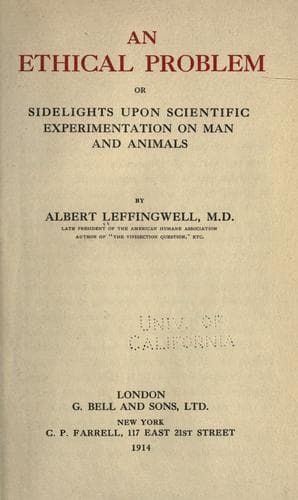
An ethical problem; or, Sidelights upon scientific experimentation on man and animalsLeffingwell, Albert
Philosophy
An ethical problem; or, Sidelights upon scientific experimentation on man and animals
Leffingwell, Albert
Medicine, Experimental; Vivisection
"In publishing, and indeed, in instituting these reckless experiments
on the effect of nitrate of sodium on the human subject, Professor
Ringer and Dr. Murrill have made a deplorably false move, which the
ever watchful opponenets of vivisection will not be slow to profit
by.... It is impossible to read the paper in last week's Lancet
without distress. Of eighteen adults to whom Drs. Ringer and Murrill
administered the drug in 10-grain doses--all but one avowed they would
expect to drop down dead if they ever took another dose. One woman
fell to the ground, and lay with throbbing head and nausea for three
hours; another said it turned her lips quite black, and upset her so
that she was afraid that she would never get over it.... One girl
vomited for two hours and thought she was dying. All these
observations are recorded with an innocent naivete as though the idea
that anyone could possibly take exception to them were far from the
writers' minds. But whatever credit may be given to Drs. Ringer and
Murrill for scientific enthusiasm, it is impossible to acquit them of
grave indiscretion. THERE WILL BE A HOWL THROUGHOUT THE COUNTRY IF IT
COMES OUT that officers of a public charity are in the habit of trying
SUCH USELESS AND CRUEL EXPERIMENTS on the patients committed to their
care...."[1]
[1] Medical Times and Gazette, November 10, 1883.
"CRUEL AND USELESS EXPERIMENTS ON PATIENTS"--that was the judgment of
a medical journal of the day. Any stronger condemnation now is hardly
necessary.
What is the judgment of the reader upon investigations of this
character? Here we have a physician making use of the bodies of his
patients for the testing of poisonous drugs, apparently without the
slightest regard for the poor and ignorant fellow-beings who had
confidently placed themselves under his care. Can such
experimentation as this be termed anything but human vivisection? Once
we admit that patients in hospitals have no rights superior to
scientific demands, and there is hardly a limit to which such
experimentation may not be carried on the poor, the ignorant, the
feeble-minded and the defenceless.
III. Experiments involving the Eye
Recent experiments with tuberculin, made upon the eyes of children and
other patients in public institutions, seem in many cases to have been
carried to an extent not easily justified by ordinary ethical ideals.
It is impossible to quote all the cases of this phase of human
experimentation; but enough can be given to afford any reader the
opportunity of judging the morality of the practice.
The experiments in question had one or more of the following
characteristics, distinguishing them from ordinary medical treatment:
Public-domain text, read in full here on John Shaqi.
Reviews
Reviews
No reviews yet
Be the first to share your thoughts on this work.
Elsewhere in the archive
Join the Discussion
Join the discussion
Sign in to leave a comment or review.
Sign InorCreate an account