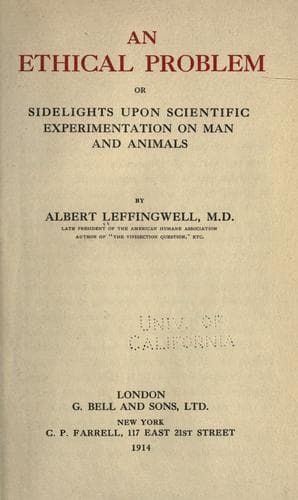
An ethical problem; or, Sidelights upon scientific experimentation on man and animals — John Shaqi
An ethical problem; or, Sidelights upon scientific experimentation on man and animalsLeffingwell, Albert
Philosophy
An ethical problem; or, Sidelights upon scientific experimentation on man and animals
Leffingwell, Albert
Medicine, Experimental; Vivisection
indeed, would the physiological laboratory hide the past from the
memory of mankind; I do not believe in acceding to that desire. When
the leading physiologist of his day, addressing an audience of
physicians, refers to an early criticism of physiological cruelty as a
collection of "blood-curdling stories," there is desire not to
investigate, but to ridicule and discredit historic facts. When men
of science put forth what they claim to be, "a plain statement of the
whole truth," without one word of reference to the abuses of the past,
they practically throw dust in the air to hide the truth from the
public eye. That it may have been done ignorantly and without any
wish to deceive is not sufficient to earn exculpation, for in either
case the evil is accomplished.
Of one English physiologist of that period, Sir Charles Bell, it is
impossible to speak except in terms of admiration and esteem. Born in
1774, his long and useful life terminated in 1842, four years before
the discovery of anaesthesia. No one can read his correspondence with
his brother, published many years after his death, without recognizing
the innate beauty and nobility of his character. When news of the
Battle of Waterloo reached England, he--the leading surgeon of his
day--started for the battlefield. The story of his experience is one
of the most graphic pictures of the effects of war to be found in
modern literature. It was Sir Charles Bell who made to physiology the
greatest contribution which had come to it since the discovery by
Harvey of the circulation of the blood, and yet this discovery was
made by reasoning upon the facts of anatomy rather than by
experimenting upon animals. An English physiologist, Sir Michael
Foster, admits this:
"To Charles Bell is due the merit of having made the fundamental
discovery of the distinction between motor and sensory fibres. Led to
this view by reflecting on the distribution of the nerves, he
experimentally verified his conclusions...."
In his lectures on the nervous system Bell himself states that his
discoveries, so far from being the result of vivisections, were, "on
the contrary, deductions from anatomy; and I have had recourse to
experiments, not to form my own opinions, but to impress them upon
others."
That which determines the judgment of the world upon human actions is
the spirit that animates them. Sir Charles Bell was not an
antivivisectionist. When experiments on animals seemed to him
absolutely indispensable, he had recourse to them, but always with
repugnance, and with desire to avoid giving of pain. In his lectures
on the nervous system he speaks thus of some of his work:
"After delaying long on account of the unpleasant nature of the
operation, I opened the spinal canal.... I was deterred from repeating
the experiment by the protracted cruelty of the dissection. I
reflected that the experiment would be satisfactory if done on an
animal recently knocked down and insensible."
Public-domain text, read in full here on John Shaqi.
Reviews
Reviews
No reviews yet
Be the first to share your thoughts on this work.
Join the Discussion
Join the discussion
Sign in to leave a comment or review.
Sign InorCreate an account