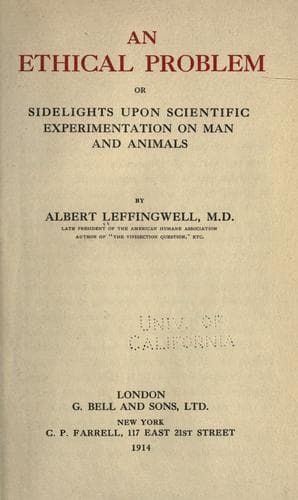
An ethical problem; or, Sidelights upon scientific experimentation on man and animalsLeffingwell, Albert
Philosophy
An ethical problem; or, Sidelights upon scientific experimentation on man and animals
Leffingwell, Albert
Medicine, Experimental; Vivisection
And on another occasion, writing to his brother, he says:
"I should be writing a third paper on the nerves; but I cannot proceed
without making some experiments, which are so unpleasant to make that
I defer them. You may think me silly, but I cannot perfectly convince
myself that I am authorized in Nature or Religion to do these
cruelties .... And yet what are my experiments in comparison with
those which are daily done, and are done daily for nothing?"
Such extreme sensibility, such sympathetic hesitancy to inflict great
suffering in an attempt to discover some fact, would be ridiculed at
the present day in every laboratory in Europe or America. It is
typical, however, of a sentiment that once prevailed. Are we any
better because it has so largely disappeared?
For great cruelty was there ever great remorse? The cases are not
many; before the self-condemnation of a dying man and the final scene,
friendship may feel it best to draw the veil. Yet one case of this
poignant regret is worthy consideration, and shall have relation.
CHAPTER V
A VIVISECTOR'S REMORSE
About the middle of the last century there died in Scotland in the
prime of life a physiologist, now almost forgotten, whose fate excited
at the time an unusual degree of compassionate interest. Born in
1809, John Reid received his medical degree when but twenty-one years
of age. A part of the two years following he spent in Paris, where
Magendie was at the height of his notoriety for the ruthless cruelty
of his vivisections. What attracted the young man we do not know, but
Reid seems to have become greatly interested in physiological
problems. Returning to Scotland, he pursued his investigations with
all the zeal of youth, and apparently with little or no regard for the
animal suffering he caused. For instance, of experiments which he
made to prove a certain theory, he tells us:
"I have exposed the trunk of the par vagum in the neck of at least
thirty animals, and in all of these the pinching, cutting, and even
stretching of the nerve WERE ATTENDED BY INDICATIONS OF SEVERE
SUFFERING. It was frequently difficult to separate the nerve from the
artery ON ACCOUNT OF THE VIOLENT STRUGGLES OF THE ANIMAL."[1]
[1] "Physiological Researches," by John Reid, p. 92. (In all
quotations the italics are the compiler's.)
Regarding the pain inflicted by him in certain other vivisections,
Reid is equally frank in his admissions:
"In repeated experiments upon the laryngeal nerves, we found in all
animals operated upon (except two dogs, which appeared CONSIDERABLY
EXHAUSTED BY GREAT PREVIOUS SUFFERING) ample ground for dissenting
from the statements of Dr. Alcock.... With the exceptions mentioned,
VERY SEVERE INDICATIONS OF SUFFERING ... ATTENDED THE PINCHING AND
CUTTING OF THE NERVE."[1]
[1] "Physiological Researches," p. 73.
Public-domain text, read in full here on John Shaqi.
Reviews
Reviews
No reviews yet
Be the first to share your thoughts on this work.
Join the Discussion
Join the discussion
Sign in to leave a comment or review.
Sign InorCreate an account