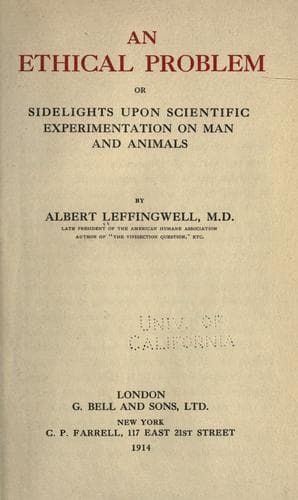
An ethical problem; or, Sidelights upon scientific experimentation on man and animalsLeffingwell, Albert
Philosophy
An ethical problem; or, Sidelights upon scientific experimentation on man and animals
Leffingwell, Albert
Medicine, Experimental; Vivisection
"Allusion has been made to the infliction of suffering on living
animals.... This suffering was not merely incidental to dissections,
but in many of the experiments recorded WAS DELIBERATELY INFLICTED.
In many of the experiments, EVEN IF ANAESTHETICS HAD BEEN KNOWN at the
period of his observations, THEY COULD NOT HAVE BEEN EMPLOYED.... It
was essential to the settlement of the question that the animal should
be left TO EXHIBIT ALL THE PAIN IT FELT, AND SHOULD BE EXPRESSLY
SUBJECTED TO TORTURE."[2]
[2] "Life of John Reid," by Geo. Wilson, M.D., 1852, p. 153.
And precisely the same apology is put forward to-day. More than once,
by high scientific authority, the public has been comfortably assured
that nowadays "anaesthetics are always employed," in severely painful
experiments, EXCEPT "in those instances in which THE ANAESTHETIC WOULD
INTERFERE WITH THE OBJECT OF THE EXPERIMENT." Truly it is a broad
exception. For all we know, it is the laboratory's excuse, even for
the present-day repetition of the experiments of Magendie, Brachet,
and Reid. "The anaesthetic would interfere." But what was the value of
all this experimentation upon mind and body, this "mental emotion of
terror" in a dog, and this calming of its fear by caresses, followed
by the torment of the operation? There was no value so far as the
treatment of human ailments is concerned. Reid's experiments led to
no change whatever in medical practice. Reading of certain
experiments, one is constantly reminded of the old peasant's reply to
his grandchild, who had found a skull on what once was a battlefield.
Holding it in his hand, the old man told the story of the Battle of
Blenheim, and the awful suffering it had caused:
"`But what good came of it at last?'
Said little Peterkin;
`Why, that I cannot tell,' quoth he,
`BUT `TWAS A FAMOUS VICTORY!'"
At the early age of thirty-eight the physiologist seemed to see before
him the bright prospect of a long and happy life. He possessed
unusual physical strength, robust health, and a resolute and
courageous spirit. His home was happy. No one considered him a cruel
man; indeed, we are told, he was rather fond of animals. "In his own
house he always had pet dogs and cats about him, and he was as ready
as Sir Walter Scott to rise from any occupation to humour their
whims." In his profession he had made somewhat of a reputation, yet
higher honours and wider renown and increased financial prosperity
seemed almost certain to await him in the not distant future.
Public-domain text, read in full here on John Shaqi.
Reviews
Reviews
No reviews yet
Be the first to share your thoughts on this work.
Join the Discussion
Join the discussion
Sign in to leave a comment or review.
Sign InorCreate an account