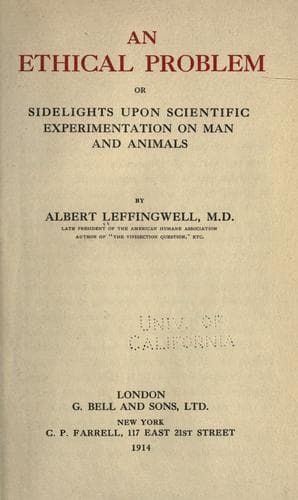
An ethical problem; or, Sidelights upon scientific experimentation on man and animalsLeffingwell, Albert
Philosophy
An ethical problem; or, Sidelights upon scientific experimentation on man and animals
Leffingwell, Albert
Medicine, Experimental; Vivisection
Some physiological observers have remarked that among the more highly
organized species of animals the creature struggles against the
ligatures previous to a second operation more than it did at its first
experience. It is evident that in such cases, in animals as well as
among human beings, the memory of agony endured creates a mental
condition of terror and fear. But what effect would the emotion of
terror have upon the heart's action if certain nerves were first
severed? Brachet relates an experiment wherein he tortured a dog in
every conceivable way, yet the heart's action was not notably
quickened if such nerves were first divided. Reid determined,
therefore, to experiment for himself upon this emotion of TERROR
induced by memory of previous pain, and six dogs were selected for his
purpose. The nerves were first "cut in the middle of the neck, and a
portion of each removed." He then tells us the results:
"After the operation, the pulsations of the heart were reckoned when
the animal was lying or standing on the ground, and AFTER IT HAD BEEN
CARESSED FOR SOME TIME TO CALM ITS FEARS. It was then lifted up on
the table, on which it had been tied, and operated upon; and after
having been spoken to HARSHLY, the pulsations were again reckoned."
In every case Reid noted that the heart's action increased from 20 to
40 beats per minute on lifting the animal to the vivisection table,
whereon it had previously suffered torment. He adds:
"In those experiments it was particularly observed that the animals
made no struggles in carrying them to and from the table, and
consequently the increased excitation of the heart MUST HAVE ARISEN
FROM THE MENTAL EMOTION OF TERROR. In a seventh dog this was
conjoined with violent struggles. The pulsations, eight hours after
the operation, were 130; WHEN PLACED ON THE TABLE AND MADE TO
STRUGGLE, the pulsations were about 220; when he had been SUBJECTED TO
PAIN, and struggled more violently, they became so frequent that they
could not be accurately reckoned. These experiments...prove that
after the section of the vagi the pulsations of the heart may not only
be quickened by muscular exertion, but also by MENTAL EMOTIONS."[1]
[1] Reid, "Physiological Researches," pp. 168-171.
Objection is often made to the citation of vivisections which occurred
before the discovery of ether or chloroform. But in these experiments
of Reid--as in those of Brachet--the use of anaesthetics, even had
they been known to him, would have been a hindrance. HOW CAN ANYONE
EXPERIMENT ON THE "MENTAL EMOTIONS" OF AN ANIMAL WHILE IT IS
PROFOUNDLY INSENSIBLE TO ALL EXTERNAL INFLUENCES? The idea is an
absurdity. The biography of Reid thus refers to this very point:
Public-domain text, read in full here on John Shaqi.
Reviews
Reviews
No reviews yet
Be the first to share your thoughts on this work.
Join the Discussion
Join the discussion
Sign in to leave a comment or review.
Sign InorCreate an account