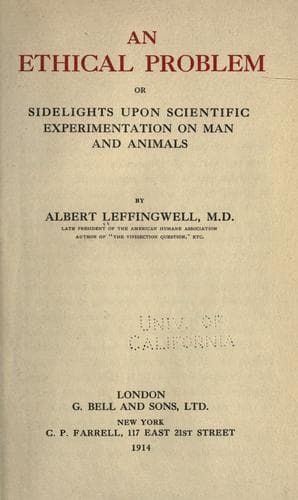
An ethical problem; or, Sidelights upon scientific experimentation on man and animalsLeffingwell, Albert
Philosophy
An ethical problem; or, Sidelights upon scientific experimentation on man and animals
Leffingwell, Albert
Medicine, Experimental; Vivisection
Early the next year (1873) was published the "Handbook of the
Physiological Laboratory," compiled by leading men of the
physiological party, among whom were Professors Sanderson, Foster, and
Klein. Describing the method of performing various experiments upon
animals, it included a particular account of some of the most
excruciatingly painful of the vivisections practised abroad. So
atrocious was one of the experiments thus described in this handbook
for students that Professor Michael Foster, who wrote the description,
afterward confessed that he had never seen or performed the experiment
himself, partly "from horror of the pain." Reviewing the work, a
medical journal justly declared that "the publication of this book
marks an era in the history of physiology in England.... It shows THE
PREDOMINANT INFLUENCE WHICH GERMANY NOW EXERCISES IN THIS DEPARTMENT
OF SCIENCE."[1] A professor of physiology, Dr. Gamgee, about the same
time, refers to the physiological laboratories of Edinburgh,
Cambridge, and London, and the part they sustained "in what I may call
the Revival of the study of experimental physiology in England."[2]
[1] Medical Times and Gazette, London, March 29, 1873.
[2] Ibid., October 18, 1873.
Emboldened by continuing success, the advocates of Continental
vivisection in England determined to advance yet another step. The
annual meeting of the British Medical Association for 1874 was to be
held that year in August in the city of Norwich. A French vivisector,
Dr. Magnan, was invited to be present, and to perform in the presence
of English medical men certain experiments upon dogs. On this
occasion, however, the public demonstration of French methods of
vivisection did not pass without protest; there was a scene; some of
the physicians present--among them Dr. Tufnell, the President of the
Royal College of Surgeons of Ireland, and Dr. Haughton of the medical
school in Dublin, denounced the experiments at the time they were made
as unjustifiably cruel. Public attention was beginning to be aroused;
it was decided to test the question, whether such exhibitions were
protected by English law, and a prosecution was instituted against
some who had assisted in performing the experiments. Dr. Tufnell
appeared to testify in regard to the cruelty of the exhibition, and
Sir William Fergusson, surgeon to the Queen, who had only just retired
from the presidency of the British Medical Association, not only
stigmatized one of the experiments as "an act of cruelty," but
declared that "such experiments would not be of the smallest possible
benefit."[1] The magistrates decided that while the case was a very
proper one to prosecute, yet the gentlemen named as defendants were
not sufficiently proven to have taken part in the experiment. The
decision was not unjust; the real offender was safe in his native
land.
[1] British Medical Journal, December 12, 1874.
Public-domain text, read in full here on John Shaqi.
Reviews
Reviews
No reviews yet
Be the first to share your thoughts on this work.
Elsewhere in the archive
Join the Discussion
Join the discussion
Sign in to leave a comment or review.
Sign InorCreate an account