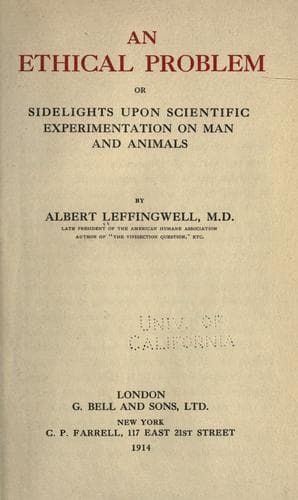
An ethical problem; or, Sidelights upon scientific experimentation on man and animalsLeffingwell, Albert
Philosophy
An ethical problem; or, Sidelights upon scientific experimentation on man and animals
Leffingwell, Albert
Medicine, Experimental; Vivisection
It is not my purpose to trace the course of the English agitation
against vivisection, except as it may be seen in the medical
literature of the time; but one cannot refer to this period without
mention of the name of Frances Power Cobbe. In 1863, while in Italy,
she had protested, and not in vain, against the cruelties of Professor
Schiff in Florence. Taking up the question again in 1874, she devoted
the remainder of her life to the advancement of her ideals of reform.
It was to her zeal that in 1875 was founded the "Society for the
Protection of Animals liable to Vivisection." At this period, then,
three phases of opinion opposed one another; first, the
antivivisectionists, who desired the total suppression by law of all
animal experimentation; second, the physiological enthusiasts, few in
number, but favourable to the introduction of the Continental
irresponsibility, and eager to free vivisection from every semblance
of restraint; and, thirdly, the great body of Englishmen and of the
medical profession, whose views we have seen reflected in medical
journals of the day. The popular attack upon all animal
experimentation became so pressing that for a time the entire medical
profession seemed to unite in its defence; and editorial space once
filled with denunciation of vivisection in France was now given over
to criticism of the antivivisectionists of England. Yet, even at this
period, there appeared no repudiation of those humane principles, so
long professed by English medical men. One leading journal, the
Medical Times and Gazette, thus suggests that very oversight of
vivisection which we are told is impossible:
"Just as the law demands that a teacher of anatomy should take out a
licence, and be responsible for the bodies entrusted to him, so a
teacher of physiology might be required to take out some such licence
as regards the teaching of practical physiology. We have never been
of those who advocate the wholesale performance of experiments by
students, especially on the higher animals, if they are of such a kind
as to require any degree of skill for their performance. When the
medical public seemed bitten with what was called `practical
physiology,' many were ready to advocate the performance of all kinds
of experiments on living animals by uninstructed students. Against
this notion we were first to protest, as being at once cruel and worse
than useless; for an experiment performed by bungling fingers is no
experiment at all, but wanton cruelty."
After explaining his position in favour of scientific research, the
editor refers to a recent discussion on vivisection in London:
Public-domain text, read in full here on John Shaqi.
Reviews
Reviews
No reviews yet
Be the first to share your thoughts on this work.
Elsewhere in the archive
Join the Discussion
Join the discussion
Sign in to leave a comment or review.
Sign InorCreate an account