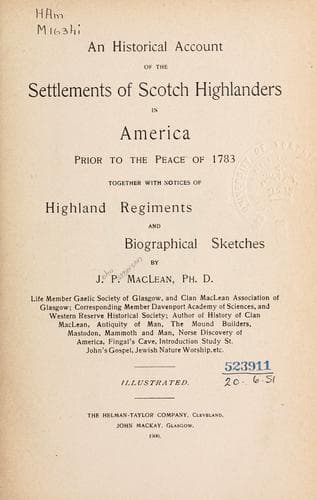
An Historical Account of the Settlements of Scotch Highlanders in AmericaMacLean, J. P. (John Patterson)
History
An Historical Account of the Settlements of Scotch Highlanders in America
MacLean, J. P. (John Patterson)
Scots -- America; Scots -- United States
During the autumn of 1741, Reverend John McLeod abandoned his Highland
charge at Darien, went to South Carolina and settled at Edisto. In an
oath taken November 12, 1741, he represents the people of Darien to be
in a deplorable condition. Oglethorpe, in his letter to the
Trustees,[92] evidently did not think Mr. McLeod was the man really fit
for his position, for he says:
"We want here some men fit for schoolmasters, one at Frederica and
one at Darien, also a sedate and sober minister, one of some
experience in the world and whose first heat of youth is over."
The long-threatened invasion of Carolina and Georgia by the Spaniards
sailed from Havana, consisting of a great fleet, among which were two
half galleys, carrying one hundred and twenty men each and an
eighteen-pound gun. A part of the fleet, on June 20th, was seen off the
harbor of St. Simons, and the next day in Cumberland Sound. Oglethorpe
dispatched two companies in three boats to the relief of Fort William,
on Cumberland island, which were forced to fight their way through the
fire from the Spanish galleys. Soon after thirty-two sail came to anchor
off the bar, with the Spanish colors flying, and there remained five
days. They landed five hundred men at Gascoin's bluff, on July 5th.
Oglethorpe blew up Fort William, spiked the guns and signalled his ships
to run up to Frederica, and with his land forces retired to the same
place, where he arrived July 6th. The day following the enemy were
within a mile of Frederica. When this news was brought to Oglethorpe he
took the first horse he found and with the Highland company, having
ordered sixty men of the regiment to follow, he set off on a gallop to
meet the Spaniards, whom he found to be one hundred and seventy strong,
including forty-five Indians. With his Indian Rangers and ten
Highlanders, who outran the rest of the company, he immediately attacked
and defeated the Spaniards. After pursuing them a mile, he halted his
troops and posted them to advantage in the woods, leaving two companies
of his regiment with the Highlanders and Indians to guard the way, and
then returned to Frederica to await further movements of the enemy.
Finding no immediate movement on the part of his foes, Oglethorpe, with
the whole force then at Frederica, except such as were absolutely
necessary to man the batteries, returned to the late field of action,
and when about half way met two platoons of his troops, with the great
body of his Indians, who declared they had been broken by the whole
Spanish force, which assailed them in the woods; and the enemy were now
in pursuit, and would soon be upon them. Notwithstanding this
disheartening report, Oglethorpe continued his march, and to his great
satisfaction, found that Lieutenants Southerland and MacKay, with the
Highlanders alone, had defeated the enemy, consisting of six hundred
men, and killed more of them than their own force numbered. At first the
Public-domain text, read in full here on John Shaqi.
Reviews
Reviews
No reviews yet
Be the first to share your thoughts on this work.
Elsewhere in the archive
Join the Discussion
Join the discussion
Sign in to leave a comment or review.
Sign InorCreate an account